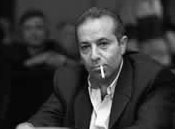
Player snapshot
- Full name: Ihsan “Sammy” Farha
- Nationality: Lebanese-American
- Date of birth: 23 February 1959
- Born: Beirut, Lebanon
- Current base: Houston, Texas, USA
- Live tournament earnings: $2,996,618 across 42 recorded cashes (Hendon Mob, latest cash 14 July 2025)
- WSOP bracelets: 3 (1996 PLO; 2006 Omaha Hi-Lo; 2010 Omaha Hi-Lo Championship)
- WPT titles: 0 (three WPT money finishes)
- EPT titles: 0
- Other major titles: Two cashes in the NBC National Heads-Up Poker Championship (5th in 2006, 3rd in 2009)
- Known playing style: Loose-aggressive, intuition-driven, Omaha specialist
- Sponsors / team: None current. Former spokesman for Harrah’s casino during the boom years.
Who is Sam Farha?
Sam Farha is the poker professional that the poker boom almost made famous for the wrong reasons. To most casual fans, he is the man across the table from Chris Moneymaker at the 2003 World Series of Poker Main Event — the slicked-back hair, the unbuttoned shirt, the unlit cigarette, the losing hand. That image has fossilised into a piece of poker folklore. It also undersells him badly.
What the Moneymaker narrative tends to obscure is that Farha was never really a tournament player in the first place. He was a high-stakes cash game specialist — and specifically, one of the most respected Pot-Limit Omaha players of his generation. Heading into the 2003 Main Event, he had only three tournament cashes on his record, all of them in Pot-Limit Omaha. His three WSOP bracelets, spanning 1996, 2006 and 2010, all came in Omaha variants. He wrote the book on the game — literally. His peers in the Bellagio “Big Game” rated his short-handed PLO as close to unplayable.
The Moneymaker hand is what people remember. The career behind it is what serious poker fans should understand: a cash game professional who wandered into the biggest tournament stage in history, played the villain role too well, and spent the next two decades being defined by a game that wasn’t really his specialty.
Early life and path to poker
Farha was born in Beirut in 1959. When the Lebanese Civil War erupted in 1975, his family relocated to the United States in search of a better life. He settled eventually in Kansas, enrolling at the University of Kansas and graduating with a degree in business administration.
Long before poker, Farha was a games hustler. The Hendon Mob biography — drawn from his own account — describes a teenage Sammy making real money on pool, pinball, and Pac-Man in Beirut, at one point playing a single game of Pac-Man for $5,000, with his pinball prowess reportedly earning him a magazine cover in Lebanon. It’s a telling backstory: the skills he eventually brought to the poker table — pattern recognition, nerve, a willingness to gamble for real money at a young age — were forged in arcades and pool halls, not card rooms.
He moved to Houston after college, worked a succession of jobs, and, according to the Hendon Mob bio, first played poker for fifty cents a hand with friends. He quit his job in 1990 to play poker full-time. That transition from amateur curiosity to professional commitment took roughly four years of steady improvement. By the mid-1990s he was a regular in some of the biggest cash games in Las Vegas.
Career timeline and breakthrough
Farha’s first meaningful tournament score arrived in the game he understood best. At the 1996 WSOP, he won the $2,500 Pot-Limit Omaha event, capturing his first gold bracelet.It was the WSOP debut of a player who had been destroying cash games for years. He would later recall that he won a bracelet the very first year he played the Series, having discovered underground Houston poker in the late 1980s and turned professional in 1990.
For most of the next seven years, he did what he had always done: played the highest-stakes Omaha cash games he could find and occasionally dabbled in tournaments. Then came 2003.
The 2003 WSOP Main Event remains the most consequential tournament in poker’s commercial history. A 27-year-old Tennessee accountant named Chris Moneymaker, who had qualified through an online satellite on PokerStars, navigated a field of 839 players and ended up heads-up against Farha for the bracelet and $2.5 million. On Day 2, Farha had lost a major pot to Barry Greenstein that left him with only about 10% of the average stack. He was considering walking away from the tournament when Greenstein convinced him to stay.Farha then shoved all-in on seven of his next eight hands and rebuilt his stack.
The decisive moment came at the final table. With blinds of 20,000/40,000 and the 5K ante, Moneymaker raised from the button with K♠7♥ and Farha called from the big blind with Q♠9♥ on a flop of 9♠2♦6♠. The hand escalated into a river shove by Moneymaker on a 5-high, flush-draw-missed board. Farha talked, tanked, and folded top pair. Norman Chad’s ESPN call that followed — describing the moment as the bluff of the century — became part of poker’s televisual DNA. Shortly after the bluff, Moneymaker got the money in with 5♦4♠ on a flop of J♠5♠4♥ against Farha’s J♥T♦; his two pair held to the river. Farha collected $1.3 million — still the largest single live tournament payday of his career.
The Main Event runner-up finish made Farha a television fixture. He became a regular on Game Show Network’s High Stakes Poker, seasons 1 through 4, and on Poker After Dark. His peak tournament years came on the back of that exposure. In 2006 he captured his second bracelet in Event #12: $5,000 Omaha Hi-Lo 8 or Better, topping a field of 265 players for $398,560, beating eight-time bracelet winner Phil Ivey heads-up for the title — a far more meaningful skill-on-skill result than most of what gets talked about in his career. Four years later, Farha captured his third bracelet in the 2010 $10,000 Omaha Hi-Low Split-8 or Better Championship, winning $488,241. In a detail that speaks to how much the win meant to him personally, Farha requested that the Lebanese national anthem be played at the ceremony — reportedly the first time it had been played at a WSOP bracelet presentation.
The 2010 bracelet would be his last. As online poker in the U.S. contracted after Black Friday in 2011, and as televised cash game programming thinned, Farha’s public profile receded. He remained active in Texas cash games, but his tournament appearances grew rarer. By his late 50s, he was telling interviewers he was semi-retired from the grind. “I played high limits for almost 14 years straight in Vegas. It wears you out.”
He has not gone away entirely, though. In 2024, aged 65, he bagged the chip lead going into Day 2 of the WSOP $1,500 Big O — a five-card PLO hi-lo variant — and finished 11th out of 1,555 entries. In June 2025 he cashed in the WSOP $1,000 Super Seniors for $14,461. He is still, by any reasonable definition, a working tournament player.
Key titles and biggest results
The following results are verified against The Hendon Mob, WSOP.com, and contemporaneous PokerNews reporting:
| Event | Year | Finish | Prize | Notes |
|---|---|---|---|---|
| WSOP Main Event, $10,000 NLHE | 2003 | 2nd | $1,300,000 | Runner-up to Chris Moneymaker; largest career cash |
| WSOP $10,000 Omaha Hi-Low 8 or Better Championship | 2010 | 1st | $488,241 | Third and most recent bracelet |
| WSOP $5,000 Omaha Hi-Lo 8 or Better | 2006 | 1st | $398,560 | Second bracelet; defeated Phil Ivey heads-up |
| WSOP $2,500 Pot-Limit Omaha | 1996 | 1st | $145,000 | First bracelet; first recorded tournament cash |
| NBC National Heads-Up Poker Championship | 2009 | 3rd | $125,000 | Deepest run in the invitational |
| NBC National Heads-Up Poker Championship | 2006 | 5th | $75,000 | First deep run in the event |
| WSOP $10,000 Pot-Limit Omaha World Championship | 2012 | 11th | $43,076 | Final-table-adjacent run in signature game |
| WSOP Main Event, $10,000 NLHE | 2010 | 452nd | $31,647 | Main Event cash |
| WSOP Main Event, $10,000 NLHE | 2005 | 316th | $21,070 | Main Event cash |
| WSOP $10,000 Omaha Hi-Lo 8 or Better Championship | 2023 | 16th | $20,483 | Recent deep run in signature game |
Read together, these results tell a clear story. Outside of one No-Limit Hold’em runner-up, every significant tournament finish of Farha’s career has come in Omaha. All three of his bracelets are in Omaha variants. His best recent results in his 60s have been in Omaha. He is, by any measure other than public recognition, one of the most successful Omaha tournament specialists in WSOP history — a distinction he shares with only a handful of players.
His total live tournament earnings of roughly $3 million also carry an important asterisk: Farha has spent most of his career in cash games, not tournaments. The Hendon Mob number captures a small slice of what he has actually earned at the table over four decades.
Playing style and strategic identity
The shorthand on Farha’s style is “loose-aggressive,” which is accurate but incomplete. A more useful way to think about him is as a player who treats poker fundamentally as a game played against opponents rather than against the cards.
Preflop, Farha is willing to play a significantly wider range than almost any of his peers, particularly in short-handed Omaha. His co-author Storms Reback wrote that Farha puts extreme pressure on opponents at all times, and that it isn’t unusual to see him raise the pot on every hand in a round.The consequence is that opponents can never construct a reliable range for him, which blunts the edge that more technically sophisticated players should theoretically have. In an era increasingly dominated by solver-trained, GTO-aware professionals, Farha represents something closer to the opposite philosophy: a player whose edge comes from reading opponents’ tendencies and imposing variance they cannot handle.
Barry Greenstein‘s long-standing assessment, often cited in poker media, is that Farha is the most feared short-handed Pot-Limit Omaha player in the world — so dominant that Greenstein’s circle will only play Omaha with him when mixed games rotate in one or two other variants. That is a remarkable tribute from a peer, and it points to where Farha’s real edge lives: in uncapped-pot, high-stakes Omaha, where his ability to play the opponent rather than the board translates directly into EV.
His image at the table was engineered. The expensive suits, the slicked-back hair, the jewellery, the unlit cigarette he kept in his mouth or fingers — Farha was not a smoker, but the cigarette became a superstitious prop he would swap out after bad beats, once joking that he was so hot his cigarette would light itself. The whole package projected effortless control and encouraged opponents to overestimate his experience while underestimating his willingness to put them in uncomfortable spots. Commentators in the early High Stakes Poker seasons noted his habit of stalling as though he intended to call, then folding abruptly — a micro-piece of table theatre that served to rattle opponents in later hands.
Under pressure, Farha has historically leaned harder on his reads than on his math. His book, co-authored with Storms Reback and published by Triumph in 2007, advises new Omaha players to be cautious about treating double-suited aces or kings as trophy hands, on the grounds that players coming from Hold’em routinely overvalue them. That is characteristic of how he thinks: fewer rigid rules, more situational judgment, more focus on what the other player is doing. The philosophy explains both his highs — a bracelet against Ivey heads-up, $50,000 nights in the Bellagio Big Game — and the 2003 Main Event hand against Moneymaker that he is most famous for. On that river he could not construct a clean read, and without the read, he folded.
In modern terms: Farha is not a GTO player. He is an exploitative player with four decades of pattern recognition, and the younger generation of tournament specialists who train on solvers will find him an awkward, variance-inducing opponent precisely because he refuses to play a balanced strategy.
Online poker and cash games
Farha’s legacy is a cash game legacy, not an online one. There is no well-documented online screen name associated with him on the major tournament sites, and he has never been a significant figure in online poker history. His rematch with Chris Moneymaker shortly after the 2003 Main Event was organised on PokerStars as a promotional exhibition rather than a competitive online pursuit — Farha won that rematch; a 2011 WSOP-organised grudge match between the two was won by Moneymaker in a best-of-three format.
His cash game résumé, by contrast, is central to understanding him. For over a decade he was a fixture in the biggest Pot-Limit Omaha games running in Las Vegas, including the Bellagio’s “Big Game.” His television cash game appearances on High Stakes Poker (seasons 1–4) are essentially the archive of his cash play — memorable pots against Doyle Brunson, Daniel Negreanu, Phil Ivey, Jamie Gold, Patrik Antonius, and Eli Elezra. The late-2000s version of Farha on HSP is, for many students of the game, the clearest window into how a high-stakes Omaha specialist actually thinks in real time.
More recently, Farha’s cash game presence has shifted to Houston. The Texas poker room scene — a patchwork of membership clubs that emerged as the state’s regulatory grey zone opened up in the late 2010s — has been his primary battleground for several years. He has been a regular at venues including the now-closed 88 Social and Legends Poker Room, though, as covered below, that presence has not been without incident.
Beyond the felt
Media and television. Farha appeared on GSN’s High Stakes Poker in seasons 1 through 4 and made a cameo appearance in the 2007 film Lucky You. He was also a regular on Poker After Dark and the NBC National Heads-Up Poker Championship during the boom years.
Writing. His 2007 book Farha on Omaha: Expert Strategy for Beating Cash Games and Tournaments, co-written with poker writer Storms Reback and published by Triumph Books, covers pot-limit, limit, and eight-or-better Omaha across cash games and tournaments. The back cover carries an endorsement from the late Chip Reese, who described Farha’s pot-limit Omaha style as standing alone at the top of the mountain.Opinions on the book vary — some readers have criticised it as lacking the technical rigour of more recent PLO theory texts, while others value it for precisely the opposite reason: it captures how an instinct-driven professional actually thinks about the game. Both readings have merit.
Sponsorships. During the boom years Farha was a spokesman for Harrah’s, the Las Vegas casino and WSOP operator. He does not currently hold a public sponsorship or ambassadorship with any major poker site or tour.
Personal life. Farha has been largely private about his personal life throughout his career and has not publicly confirmed details about a spouse or children in any verified poker media interview. He has been based in Houston for most of his adult life and remains there today.
A common name confusion. A separate “Sam Farha” runs a U.S.-based exotic snack and soda company called Rare Munchiez and is a different person — a young entrepreneur unrelated to the Lebanese-born poker professional. The poker player has no documented business connection to that brand. Search engines tend to blend the two; readers looking for the poker pro can disregard the Rare Munchiez results.
Controversies and complex reputation
Farha’s public reputation has, in his later career, become more complicated than his boom-era fan-favourite status suggested.
In December 2021, PokerNews and multiple other outlets reported on a physical altercation at the Legends Poker Room in Houston. Farha was involved in an incident involving a former dealer known locally as “AJ” or “Amjad,” with the dispute reportedly originating at the nearby 88 Social club where the dealer had previously worked. According to witnesses cited by PokerNews, Farha indicated he objected to the dealer’s presence in the room, the two exchanged words, and the dealer slapped Farha before management and police were called to the scene. A GoFundMe page was later organised by members of the Houston poker community to help cover legal costs for the dealer, raising hundreds of dollars and drawing public comments critical of Farha’s treatment of dealers.
A second source in the same PokerNews report characterised the incident as the culmination of a longer-running pattern of complaints from Houston dealers about Farha’s behaviour at the table. Poker.org’s subsequent coverage noted that Farha has become, by reputation, one of the more disliked players in the Houston poker scene, even as it also observed that the original online reports initially and erroneously named a different player as the one who had struck him.
Farha’s side of the story has been sparser in the media record. He was seen at Legends the following day speaking with a police officer and reportedly attempted to file a report over the incident. No documented outcome from any legal proceeding has been publicly reported.
It is fair to say — based on the volume and consistency of public statements from Houston dealers and players — that Farha is not universally liked in the city’s poker community. It is also fair to say that his reputation on the broader tour, particularly during his peak years, was more mixed than unanimously negative: peers like Barry Greenstein have publicly praised his skill and at critical moments supported him (including in the 2003 Main Event). Readers can weigh these threads themselves. What is incontrovertible is that the 2021 incident marked a public inflection point in how Farha is discussed in poker media — a shift from boom-era icon to a more contested figure.
Current status and what to watch
At 67, Farha is still playing. He is no longer a fixture on the highest-stakes cash game circuit or on televised poker; he has not, by his own account to PokerNews in recent years, kept up the Vegas grind at the volume he once did. His poker life is now centred in Houston cash rooms and a handful of WSOP Omaha events each summer.
That last piece is the one to watch. In 2023 he finished 16th in the WSOP $10,000 Omaha Hi-Lo 8 or Better Championship, his signature event. In 2024 he went deep in the $1,500 Big O, bagging the overnight chip lead before busting in 11th. In June 2025 he cashed in the Super Seniors. For a player in his late 60s who has openly admitted the full-time Vegas schedule wore him out, these are meaningful results in a difficult discipline.
During his 2024 run, he told PokerNews he never cared about the spotlight — he was playing to win, not for attention, and winning or losing was not going to change his life at this point. A fourth bracelet, 30 years after his first, would be one of the more unusual longevity stories in WSOP history. Watch the mixed-game Omaha events at the 2026 Series: if Farha enters, he is still capable of running deep.
Farha’s verified live tournament earnings stand at $2,996,618 across 42 recorded cashes, according to The Hendon Mob (verified May 2026). That figure is misleading on its own, however — the bulk of his career has been spent in private high-stakes cash games, particularly Pot-Limit Omaha, where winnings are not publicly tracked. His $1.3 million payday for finishing runner-up in the 2003 WSOP Main Event remains his largest single live tournament cash.
Three. All of them came in Omaha events: the 1996 $2,500 Pot-Limit Omaha ($145,000), the 2006 $5,000 Omaha Hi-Lo 8 or Better ($398,560 — beating Phil Ivey heads-up), and the 2010 $10,000 Omaha Hi-Lo 8 or Better Championship ($488,241). He has not won a bracelet since 2010.
Farha is a loose-aggressive, intuition-driven Omaha specialist. His edge comes from playing the opponent rather than the cards: extremely wide preflop ranges, constant pressure, and reads developed over four decades of high-stakes cash play. He is not a solver-trained GTO player and openly favours exploitative judgment over rigid balance.
He was born in Beirut, Lebanon, on 23 February 1959. His family moved to the United States after the outbreak of the Lebanese Civil War in 1975. He attended the University of Kansas, then settled in Houston, Texas, where he still lives.
Yes. He is no longer a fixture on the highest-stakes televised cash game circuit, but he remains active in Houston poker rooms and continues to play selected WSOP Omaha events. He cashed in the WSOP $1,000 Super Seniors in June 2025 and entered the $1,500 Big O at the 2025 Series, his most recent recorded action at time of writing.
There is no verified figure. The widely cited “$100 million” estimate that appears on celebrity-net-worth aggregator sites is not sourced to Farha, his representatives, or any primary financial filing — and competing aggregators have published a “$120 million” figure with equally little support. A more honest answer is that Farha’s verified live tournament earnings are just under $3 million, that his private cash game winnings over four decades are not publicly knowable, and that any specific net worth figure on the internet for him should be treated as speculation.
To the extent he is wealthy, the source is high-stakes Pot-Limit Omaha cash games rather than tournaments. From the mid-1990s onward Farha was a fixture in the Bellagio’s “Big Game” and other elite Las Vegas Omaha lineups, where pots could reach six figures and a single session’s results often dwarfed an average WSOP cash. His tournament wins, his book, his Harrah’s spokesman role and his television appearances on High Stakes Poker added income on top, but the cash games were always the engine.
No. Rare Munchiez is an exotic snack and soda company associated with a different individual who shares the name “Sam Farha” — a younger U.S.-based entrepreneur with no documented connection to the Lebanese-born poker professional. The two are routinely confused in search results but are not the same person.