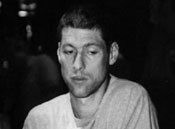
Player Snapshot
| Full name | Huckleberry “Huck” Seed |
| Nationality | American |
| Date of birth | 15 January 1969 |
| Hometown / base | Born in Santa Clara, California; raised in Corvallis, Montana; based in Las Vegas, Nevada |
| Height | 6’7″ (variously reported as 6’6″) |
| Live tournament earnings | $7,910,632 (Hendon Mob, verified May 2026) |
| WSOP bracelets | 4 |
| WSOP Main Event title | 1 (1996) |
| Other major titles | 2009 NBC National Heads-Up Championship; 2010 WSOP Tournament of Champions |
| All Time Money List rank | 260th (Hendon Mob, May 2026) |
| Known playing style | Patient, analytical, unorthodox; mixed-game specialist with a Razz pedigree |
| Notable sponsorships | Former Full Tilt Poker “red pro” (defunct); current Phenom Poker ambassador |
| Hall of Fame | Poker Hall of Fame inductee, 2020 |
Who is Huck Seed?
For most of the last decade, the safest answer to “where is Huck Seed?” was “not at the World Series of Poker.” Then, in May 2025, the 1996 world champion walked back into the Horseshoe Las Vegas after nearly a decade away and proceeded to cash eleven times, very nearly winning a fifth bracelet 22 years after his fourth. The comeback wasn’t nostalgia. According to a PokerNews interview at the 2025 WSOP, what brought Seed back was Phenom Poker — a crypto-backed, community-owned site he ambassadors — and a running bet with its founder, Matt Valeo.
That story — return, near-miss, quiet exit — captures Seed in microcosm. He is the Caltech electrical-engineering dropout who built a $1 million bankroll in eighteen months at $15/$30 limit, became the third-youngest WSOP Main Event champion in history at 27, and then spent twenty years drifting between the biggest cash games in Las Vegas, periodic deep tournament runs, and a parallel career as poker’s most committed prop bettor. He has four WSOP bracelets, over $7.9 million in verified live earnings according to the Hendon Mob, and a Poker Hall of Fame plaque secured in 2020.
He also has a reputation, mostly built by other people, that he himself politely declines to perform. Seed plays poker the way he played basketball at Caltech: tall, quiet, technically sound, slightly out of place in the cultural environment around him.
Early Life and Path to Poker
Seed was born in Santa Clara, California, on 15 January 1969 and raised in the small town of Corvallis, Montana, where he attended Corvallis High School and made the 1987 Montana All-State basketball team. According to the official 2020 Poker Hall of Fame announcement on WSOP.com, his 6’7″ frame and basketball talent took him to the California Institute of Technology, where he studied electrical engineering and starred on Caltech’s basketball team — a stint immortalised in the 2006 documentary Quantum Hoops, which chronicled the team’s long losing streak and eventual return to relevance.
The poker pull came fast. In a 2025 interview on the Table 1 Podcast, recounted by Card Player, Seed described dropping out of Caltech at 20 with $10,000, grinding $15/$30 limit hold’em for three months, and turning that bankroll into roughly $15,000 a month. He never returned to school. By the time he was 21, in his own telling, he had a million dollars. He paused, briefly considered going back to “math and science,” and decided poker was the better game.
Eli Elezra, one of the high-stakes players who later faced Seed in Vegas cash games, has said Seed’s arrival changed the texture of the room — that he became, in Erik Seidel‘s much-quoted phrase, “the first player to break Chip and Doyle’s 30-year hegemony in cash games.” It’s a line that surfaced repeatedly during Seed’s 2020 Hall of Fame campaign and explains why his peers ranked him so highly despite a tournament résumé thinner than Phil Ivey‘s or Phil Hellmuth‘s.
Career Timeline and Breakthrough
Seed’s first recorded tournament cash arrived at the 1990 WSOP, where, according to PokerNews, he posted top-ten finishes in eight of his first nine WSOP cashes. He won his first bracelet in 1994 at age 25, taking Event #3, the $2,500 Pot-Limit Omaha, for $167,000 — confirmed by both PokerNews and the Card Player Hall of Fame writeup.
Two years later came the moment that defined his career on paper. At the 1996 WSOP Main Event, Seed entered the final table second in chips at a six-handed table that included John Bonetti, Men “The Master” Nguyen, and Dr. Bruce Van Horn. According to a detailed PokerNews retrospective, heads-up play lasted long enough to be one of the longest finales in Main Event history at the time. Seed entered heads-up trailing Van Horn by a 2-to-1 chip margin, doubled up with pocket queens against Van Horn’s ace-jack, and then secured the title with 9♦-8♦ on a 9♥-8♠-4♣ flop against Van Horn’s K♣-8♣. An ace of clubs on the turn gave Van Horn a flush draw; the 3♠ on the river didn’t change anything. The pot — 2,328,000 in chips — was the largest in WSOP history at that point. At 27, Seed became the third-youngest Main Event champion behind only Stu Ungar and Phil Hellmuth.
There was, famously, no television footage. As PokerNews has noted in coverage of that era, the 1996 WSOP had no broadcast deal, so unlike Hellmuth’s 1989 victory or Chris Moneymaker’s 2003 run, the iconic final hand of Seed’s championship exists only in box-score form.
The post-Main Event years brought a steady drumbeat of high-quality results without ever quite producing another seven-figure score. Seed final-tabled the 1999 Main Event, busting in sixth to eventual champion Noel Furlong. He picked up his third bracelet in 2000, taking Event #17, the $1,500 Limit Razz, for $77,400. His fourth — and, until further notice, last — came in 2003 in the $5,000 Limit Razz, where he beat Phil Ivey heads-up for $71,500, according to PokerNews and Card Player.
The next clear peak came in 2008–2010. Seed made back-to-back final tables in the $50,000 H.O.R.S.E. event in 2008 and 2009, won the 2009 NBC National Heads-Up Poker Championship for $500,000 (improving his all-time record in that event to 18–4, per Wikipedia citing tournament records), and then captured the 2010 WSOP Tournament of Champions for another $500,000, beating Howard Lederer heads-up. None of those carried bracelets, but together they cemented him as one of the strongest mixed-game and short-handed players of his generation.
After 2011, the tournament trail thinned. Seed’s last WSOP cash before his comeback came in 2016, finishing 32nd in an event for $2,597, per the Hendon Mob.
Key Titles and Biggest Results
| Event | Year | Finish | Prize | Notes |
|---|---|---|---|---|
| WSOP Main Event ($10,000 NLHE) | 1996 | 1st | $1,000,000 | Career-high score; third-youngest Main Event champion in WSOP history at the time |
| WSOP Tournament of Champions | 2010 | 1st | $500,000 | Invitational freeroll; defeated Howard Lederer heads-up |
| NBC National Heads-Up Poker Championship | 2009 | 1st | $500,000 | Cashed in every edition of the event |
| WSOP $2,500 Pot-Limit Omaha | 1994 | 1st | $167,000 | First WSOP bracelet |
| WSOP $1,500 Limit Razz | 2000 | 1st | $77,400 | Third bracelet |
| WSOP $5,000 Limit Razz | 2003 | 1st | $71,500 | Beat Phil Ivey heads-up; most recent bracelet |
| WSOP Main Event | 1999 | 6th | $107,250 | Second WSOP Main Event final table |
| WSOP $1,500 Stud Hi-Lo 8 or Better | 2025 | 2nd | $102,281 | First WSOP final table since 2010; lost heads-up to Blaz Zerjav |
| WSOP $50,000 H.O.R.S.E. | 2008 | 7th | $280,000+ | Final table in poker’s most prestigious mixed event |
| WSOP $50,000 H.O.R.S.E. | 2009 | Final table | – | Back-to-back final table in the same event |
Collectively, the table tells a clear story. Seed is a mixed-game specialist with one breakthrough no-limit hold’em result — the Main Event — followed by a steady production of bracelets and deep runs in Razz, H.O.R.S.E., and short-handed formats. The Hendon Mob ranks him 260th on its all-time money list as of May 2026, but as Erik Seidel and other peers have argued publicly, his cash-game record adds a substantial body of un-tracked winnings that the tournament database doesn’t reflect.
Playing Style and Strategic Identity
Seed is one of the quieter top-tier American pros of his era — a fact that almost every interview with him reinforces. The Hendon Mob’s biographical note describes him as “a very tall yet introverted presence at the tables… well known for his coolness under pressure and athletic prowess giving him his edge.” That matches his own description of his 1996 Main Event approach. As Seed told GGPoker in a widely re-quoted recollection: “The main thing was trying not to get too anxious. In past years, I would get up to 50,000 or 100,000 in chips, then get knocked out. I was determined not to play too aggressively. If I managed to get a lot of chips, I planned to try to hold on to them.”
That deliberate, controlled tempo became his signature. Across multiple PokerNews interviews and the 2025 Table 1 Podcast appearance, Seed has described his game in roughly the same terms he might describe a math problem: patience, careful bankroll management, and a preference for situations where he holds an analytical edge rather than a psychological one.
He is also, on the evidence, one of the strongest pre-2010 mixed-game players in the world. Three of his four bracelets came in non-hold’em variants — Pot-Limit Omaha and two Limit Razz titles — and his 2008 and 2009 deep runs came in the $50,000 H.O.R.S.E., now the Poker Players Championship and widely regarded as the toughest event on the WSOP schedule. His 2025 final table also came in a stud-based mixed format. The pattern is consistent: Seed thrives in environments where pure NLHE muscle isn’t enough and game-flow reads across multiple variants matter.
The newer generation’s reaction to his return is instructive. In interviews leading up to his 2025 deep run, Seed told PokerNews he estimated his own bracelet odds at roughly 20-to-1. He nearly converted, finishing runner-up to Slovenia’s Blaz Zerjav after holding a substantial chip lead deep into heads-up play — a reminder that the analytical core of his game has held up reasonably well against modern solver-trained competition, even when the surrounding metagame has shifted underneath him.
Online Poker, Cash Games, and the Big Game
In the Full Tilt Poker era, Seed played under the screen name HuckleberrySeed and was a sponsored “red pro” on the site, per Wikipedia and SoMuchPoker. Specific online cash-game results are not part of the public record; Full Tilt’s collapse in 2011 took most of that history with it.
His live cash-game footprint is more documented. According to SoMuchPoker and Card Player, Seed was a fixture in Bobby’s Room at the Bellagio — the highest-stakes live poker room in the United States during the mid-2000s — and was a recurring guest on Poker After Dark, featuring on the show’s very first episode in January 2007. He later played $200/$400 NLHE on the same programme against Doyle Brunson,Tom Dwan and Johnny Chan. According to Card Player, Seed’s earnings in private cash games over decades are believed to substantially exceed his tournament totals, though by their nature these numbers cannot be independently verified.
In 2010, Seed and partner Allen Cunningham won the Full Tilt Poker Doubles Championship for $500,000 — a quirky two-handed format that suited his short-handed strengths.
Beyond the Felt: Prop Bets and the Quantum Hoops Cameo
Seed’s reputation as a proposition bettor has, in his own words, been amplified beyond reality. He has repeatedly told interviewers he loses more of these bets than the public thinks. But several are well documented:
- The ocean bet. Seed wagered with Phil Hellmuth — sources variously cite $10,000 and $50,000 — that he could stand submerged to his shoulders in the ocean for either 18 or 24 hours. Per PokerNews, Wikipedia, and Cigar Aficionado, he lasted around three hours wearing a wetsuit before paying out. Seed has said on the Table 1 Podcast that the bet has been “incorrectly reported” in most retellings.
- The desert golf bet. Seed wagered (Card Player and Cigar Aficionado report a six-figure sum) that he could break 100 four times in a single day on a desert course using only a 5-iron, sand wedge, and putter, on a day chosen by the bettor in temperatures reaching 120°F, without a cart. He won — Howard Lederer, who watched, has said publicly Seed actually improved with each round.
- The standing backflip. Seed bet Howard Lederer he could learn a standing backflip within months. He won; SoMuchPoker has noted that Seed’s uncle was a former acrobat who had taught him tricks as a child — context that Lederer didn’t have when he booked the wager.
- The shaving bet. Seed wagered he could go a full year without shaving. According to multiple PokerNews recountings, he abandoned the bet after a death in the family required him to appear at a funeral.
- The one-leg dash. Seed bet Howard Lederer he could beat him in a 50-yard dash hopping on one leg. After watching a practice run, Seed paid the $5,000 out without attempting the race.
- The mile bet. Seed bet Doyle Brunson he could run a mile in 4:40. He ran 4:47 and lost, per PokerNews.
Off the felt, Seed appeared in the 2006 documentary Quantum Hoops about Caltech basketball. He maintains a low public profile otherwise — no published book, no training site, no high-volume social presence — and is not known for podcast, streaming, or commentary work outside his recent guest appearances during the 2025 WSOP run.
Current Status and What to Watch
Seed’s most recent Hendon Mob cash was $2,104 on 20 February 2026 — confirmation that, contrary to his 2023 remarks in Vietnam suggesting he was finished, he is still playing.
He remains an ambassador for Phenom Poker, the crypto-backed online site that he has publicly credited with rekindling his interest in the game. The site experienced a security incident in April 2026, with the operator confirming a hack that compromised liquidity-pool funds; the site returned online after security checks. Per PokerOrg’s coverage, Phenom’s ambassador roster (Seed, Brian Rast, Viktor Blom, Phil Laak among others) did not make public statements at the time.
For 2026, the watch points are clear. Seed has now made one WSOP final table in eleven years; whether 2025 was a one-off motivated by curiosity or the start of a sustained Vegas-summer schedule will be apparent at the 2026 WSOP, which runs at Horseshoe and Paris Las Vegas from late May through July. If he plays a similar volume to 2025, a fifth bracelet — particularly in a mixed-game event — is a credible target rather than a sentimental one.
FAQ
Seed has $7,910,632 in verified live tournament earnings, according to the Hendon Mob’s profile updated through February 2026. That ranks him 260th on the all-time live tournament money list. The figure does not include cash-game winnings, online play, or proposition bets, all of which Card Player and other outlets have suggested may substantially exceed his tournament totals over a 35-year career.
Four. Seed won the 1994 $2,500 Pot-Limit Omaha for $167,000, the 1996 WSOP Main Event for $1,000,000, the 2000 $1,500 Limit Razz for $77,400, and the 2003 $5,000 Limit Razz for $71,500 (defeating Phil Ivey heads-up). He has not won a bracelet since 2003 but came within a single heads-up match of a fifth in June 2025, finishing runner-up in the $1,500 Stud Hi-Lo 8 or Better.
Seed is patient, analytical, and unorthodox — a mixed-game specialist with a Caltech engineering background who plays at a deliberately controlled tempo. He is best known for his proficiency in Razz, H.O.R.S.E., and other non-hold’em formats; three of his four WSOP bracelets came in non-hold’em events. Peers describe him as quiet and difficult to read at the table.
Seed was born in Santa Clara, California, on 15 January 1969 and raised in Corvallis, Montana, where he attended Corvallis High School and made the 1987 Montana All-State basketball team. He has been based in Las Vegas, Nevada for most of his professional career.
Yes. After largely stepping away from the game between roughly 2016 and 2025, Seed returned to the 2025 World Series of Poker and recorded eleven cashes, including a runner-up finish in the $1,500 Stud Hi-Lo 8 or Better. His most recent Hendon Mob cash was in February 2026. He has publicly credited online platform Phenom Poker, where he is an ambassador, with rekindling his interest in the game.
The Hendon Mob lists Seed at $7,910,632 in total live earnings across 149 career cashes, ranking 260th on the all-time live tournament money list as of May 2026. His best single live cash remains $1,000,000 from the 1996 WSOP Main Event. The Hendon Mob biographical note describes him as “an enigmatic character… well known for his propensity to accept sick proposition bets, his coolness under pressure and athletic prowess giving him his edge.”
Public estimates vary widely and should be treated with caution — net worth for poker players is inherently speculative because cash-game and online winnings are private. Gutshot Magazine estimated Seed’s net worth at $4 million as of 2024, though this figure is not independently verifiable and does not appear to reflect his decades of high-stakes cash-game play in Bobby’s Room and on Poker After Dark. The only number that can be cleanly verified is his Hendon Mob tournament total of $7.9 million.
The two most widely cited are the ocean bet — a wager with Phil Hellmuth (variously reported at $10,000 or $50,000) that Seed could stand in the ocean to his shoulders for 18 to 24 hours; he lasted around three hours and lost — and the desert golf bet, in which Seed broke 100 four times in a single day on a desert course using only a 5-iron, sand wedge, and putter, in 120°F heat without a cart. Other documented wagers include a successful standing backflip bet with Howard Lederer, an abandoned year-without-shaving bet, a lost one-legged 50-yard dash against Lederer, and a lost mile-run challenge against Doyle Brunson. Seed has noted on the Table 1 Podcast that the ocean bet in particular has been misreported in most public accounts.