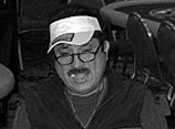
Player snapshot
- Full name: Humberto Brenes
- Nickname: “The Shark”
- Nationality: Costa Rican
- Date of birth: 8 May 1951 (San José, Costa Rica)
- Current base: San José, Costa Rica (also keeps a home in Florida)
- Live tournament earnings: $6,202,691 (source: The Hendon Mob, verified May 2026)
- WSOP bracelets: 2 (both 1993)
- WPT titles: 0 (three WPT final tables)
- EPT titles: 0
- Other notable: First Latin American player nominated to the Poker Hall of Fame (2013, 2014, 2016)
- Playing style: Exploitative, intuition-led, table-talk specialist
- Sponsors / team: Long-time Team PokerStars Pro (joined 2006)
Who is Humberto Brenes?
Most professionals try to be unreadable at the table. Humberto Brenes built a career doing the opposite. The Costa Rican is the loudest, most theatrical figure poker has produced — the man in the bright tracksuit and stacked pairs of glasses who pulls a plastic toy shark from his pocket, “swims” it across his cards, and warns opponents that it is hungry for their chips. That shark is the source of his nickname, and the nickname long ago outgrew the man: at any major festival, “The Shark” is recognised by fans who could not name a single hand he has played.
But the persona has always masked a serious record. Brenes has $6,202,691 in documented live tournament earnings according to The Hendon Mob (verified May 2026), two World Series of Poker bracelets, and more than three decades of cashes against the best players alive. He is, by a wide margin, the all-time money leader from Costa Rica, and one of the pioneers who dragged Latin American poker onto the global stage before the game had a television audience. When fans search his “net worth,” they are usually reaching for that earnings figure — but as this profile explains, the two are not the same thing, and in Brenes’s case the gap is unusually large.
In an era later defined by media-built stars like Daniel Negreanu and Chris Moneymaker, Brenes was already a grey-haired veteran who had been flying to Las Vegas since the 1980s. That longevity, more than any single trophy, is his defining trait — and in 2025, at 73, he was still winning.
Early life and path to poker
Brenes did not arrive at poker through the modern pipeline of online grinding and solver study. He grew up in San José, was educated at Colegio La Salle, and earned a degree in industrial engineering from the University of Costa Rica. By his own account he learned cards at age seven, watching his father play socially with friends — and reportedly disliking how often his father handed money back to opponents he had beaten.
Before poker, Brenes was a businessman and a casino gambler. He built and held interests in restaurants, cafés, casinos and other ventures in Costa Rica, and for roughly 35 years has owned an industrial nut-processing company, alongside a chain of San José coffee shops. His first serious gambling income, though, came from craps and baccarat in the casinos of the Bahamas — one widely repeated account, via PokerListings, has him taking $377,000 from a single craps tournament. It was the search for a stiffer challenge, rather than money, that pushed him toward poker against professionals.
That challenge brought him to the WSOP Main Event for the first time in May 1987, where he finished 14th for $12,500 in a 152-player field — despite, he later said, speaking almost no English at the time. He has credited his early development to a Costa Rican mentor, Andrés “El Pemorado” Calderón. From the start, Brenes was part of a tight Costa Rican contingent: he, his brothers Alex Brenes and Eric Brenes, and their friend Jose Rosenkrantz became known as the “Costa Rican Connection,” with Brenes the acknowledged “godfather” of the group.
Career timeline and breakthrough
The 14th-place debut in 1987 announced him; the following year made him a contender. In 1988, Brenes reached the final table of the WSOP Main Event and finished fourth, in a field that would become one of the most storied in the game’s history. The event was won by Johnny Chan for his second straight title; Erik Seidel finished runner-up in the hand later immortalised in Rounders; and T.J. Cloutier also reached the final table. Brenes went out in fourth when his pocket deuces ran into Seidel’s pocket aces — a beat he can still recount move-by-move, and one that left him roughly $83,050 richer (per The Hendon Mob).
His true breakthrough came five years later. At the 1993 WSOP, Brenes won both of his gold bracelets in a single summer — the $2,500 Limit Hold’em event (around $149,000) and the $2,500 Pot-Limit Omaha event (around $128,000). Two titles in one series is a feat that has eluded most Hall-of-Famers, and it cemented him as more than a charismatic face.
The commercial peak arrived during the poker boom. In January 2002 he took his first major open-field title at the Jack Binion World Poker Open in Tunica, reportedly worth around $500,000. Then, in December 2004, came the biggest cash of his career: runner-up at the WPT Five Diamond World Poker Classic at the Bellagio, where he survived a stacked 376-player field — including Jennifer Harman (4th) and Johnny Chan (8th) at the final table — before losing heads-up to Daniel Negreanu. Negreanu took $1,770,218 and the title; Brenes banked $923,475, which remains his largest single payday two decades later. He reached that final table as the short stack of the nine and was, by his own telling, proud simply to outlast everyone but the chip leader.
The boom also brought sponsorship. In 2006, after a record-tying eight cashes at that year’s WSOP, PokerStars approached him to join its pro team — the first time in his career he stopped paying his own buy-ins. His deepest boom-era Main Event run came that same year, 36th out of 8,773 for $329,865, his biggest WSOP cash. There was no dramatic collapse afterward, simply the slow arithmetic of age against ever-larger fields. Today Brenes is an elder statesman who still travels and still cashes — his most recent recorded result on The Hendon Mob is a June 2025 entry, and in early 2025 he won the Seniors event at the inaugural Costa Rica Poker Festiva, his first trophy in 17 years.
Key titles and biggest results
| Event | Year | Finish | Prize (approx.) | Notes |
|---|---|---|---|---|
| WPT Five Diamond World Poker Classic (Bellagio) | 2004 | 2nd | $923,475 | Lost heads-up to Daniel Negreanu; largest career cash |
| World Poker Finals (Foxwoods) | 2004 | 3rd | ~$636,000 | Figure per 2025 interview — editor to confirm exact year |
| Jack Binion World Poker Open, NLHE Championship (Tunica) | 2002 | 1st | ~$500,000 | First major open-field title |
| WSOP Main Event | 2006 | 36th | $329,865 | Largest WSOP cash; field of 8,773 |
| WSOP $2,500 Limit Hold’em | 1993 | 1st | ~$149,000 | First bracelet |
| WSOP $2,500 Pot-Limit Omaha | 1993 | 1st | ~$128,000 | Second bracelet, same summer |
| WSOP Main Event | 1988 | 4th | ~$83,050 | Final table behind Chan and Seidel |
| WSOP Main Event | 1987 | 14th | $12,500 | First-ever WSOP cash |
Taken together, the record describes a remarkably consistent final-table presence rather than a serial champion. Brenes has racked up roughly 23 WSOP final tables and well over a hundred WSOP cashes across his career (reported figures vary by source and date, from the low-90s upward), yet his trophy count is modest relative to his fame. He is the archetype of the durable tournament regular: dozens of deep runs, several agonising second- and third-place finishes, and an uncanny ability to keep showing up in the money decades after his contemporaries retired. Notably, official WSOP records credit him with about $2.4 million of his earnings from WSOP play alone.
Playing style and strategic identity
Brenes is the definitive old-school “feel” player, and he predates the GTO era by a generation. His edge has never come from balanced ranges or solver outputs; it comes from reads, tempo control, and relentless psychological pressure. The toy shark, the singing, the chatter, the chants of “shark, shark!” — all of it is engineered to do one thing: knock opponents off their game and provoke decisions made in irritation rather than logic. Behind the carnival act sits a cautious, disciplined player who is happiest in Limit and Pot-Limit formats, where his control of pot size and his patience are worth more than raw aggression.
He has also been candid about managing his own temperament. Brenes plays with a headset, and has said the music is there to relax him and curb his own impulse to gamble — an unusual admission from a man whose table image is all impulse and noise. That self-awareness is the tell that the persona is a tool, not the player.
His relationship with the modern game is complicated. The opponents who grew up on poker training sites can find his methods quaint; the ones who actually sit with him discover that a chatty, joking 74-year-old is extracting information the entire time. In an age where edges are measured in fractions of a big blind, Brenes’s continued profitability over 35 years is itself the strongest argument for his read-based style — he has simply outlasted nearly everyone who once dismissed it.
Online poker and cash games
Brenes’s profile has always been built on the live felt rather than the cash-game streaming circuit, but his online footprint is significant for one reason: PokerStars. As a long-standing Team PokerStars Pro from 2006, he played online under the screen name “Humberto B.” and became one of the most recognisable ambassadors the site fielded, particularly across Latin America and Spain. His value to the platform was never high-stakes cash-game results; it was the marketing power of the shark, the smile and the story. He is not primarily a cash-game figure, and there is little documented high-stakes cash history of the kind associated with the modern streamed-game era.
Beyond the felt
Off the table, Brenes is genuinely a businessman first. His nut-processing company, NUECES INDUSTRIALES, has run for roughly 35 years, and he has held interests in cafés, restaurants, casinos and other ventures in Costa Rica — context that matters enormously for the “net worth” question, since his wealth is tied to private business rather than published prize money. He is married to Patricia and is a father of several children.
His most meaningful contribution to the game is arguably ambassadorial. As the public face of Costa Rican poker, he helped build a competitive culture in his home country and was the first Latin American player nominated for the Poker Hall of Fame (2013, 2014 and 2016). The nickname itself reflects an off-table cause: Brenes has tied the shark persona to ocean conservation, presenting himself as a defender of the animal whose name he carries.
Current status and what to watch
At 74, Brenes has not retired, and that is the headline. He remains an active tournament player who still travels to major festivals, still cashes — his most recent recorded result dates to mid-2025 — and, in early 2025, won the Seniors event at the first-ever Costa Rica Poker Festival in his home country. He has spoken about a specific remaining ambition: he has cashed in the WSOP Main Event around nine times and sits a couple short of the all-time record for Main Event cashes. For a man whose entire identity is built on showing up year after year, chasing that record is the perfect late-career storyline. The thing to watch over the next 12 months is simple: whether the Shark adds another deep Main Event run — or another home-soil trophy — to a résumé that already spans nearly 40 years.
FAQ
Humberto Brenes has $6,202,691 in live tournament earnings according to The Hendon Mob (verified May 2026). That figure covers documented live results only; roughly $2.4 million of it comes from WSOP play. It does not include private cash-game or business income.
There is no verified, credible net-worth figure for Humberto Brenes, and any specific number you see online should be treated as speculation. His documented poker earnings are about $6.2 million in live play, but he is also a long-time businessman — owner of an industrial nut company and a café chain — so his actual wealth is private and cannot be reliably estimated from poker data alone.
Brenes earned the nickname through the plastic toy shark he uses as a card protector, “swimming” it across the table and telling opponents it is hungry for their chips. He has also linked the shark to his interest in ocean conservation. The card protector became a global trademark after he joined Team PokerStars in 2006.
Humberto Brenes has two WSOP bracelets, both won in 1993 — in the $2,500 Limit Hold’em and $2,500 Pot-Limit Omaha events. Winning two bracelets in a single summer is a rare achievement, and he has reached numerous WSOP final tables since without adding a third.
Brenes is an exploitative, intuition-based player rather than a GTO technician. He relies on psychological pressure, table talk and tempo control, and is strongest in Limit and Pot-Limit formats. Behind the theatrical persona is a cautious, disciplined game that has kept him profitable for more than 35 years.
Humberto Brenes is from San José, Costa Rica, born there on 8 May 1951. He is Costa Rica’s all-time live tournament money leader and is widely regarded as the “godfather” of Costa Rican poker. He also keeps a home in Florida.
Yes. Brenes remains active in his mid-70s, still travelling to major festivals and recording cashes as recently as 2025, when he also won the Seniors event at the inaugural Costa Rica Poker Festival. He has spoken about chasing the all-time record for WSOP Main Event cashes.