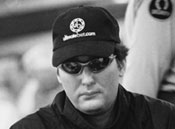
Player snapshot
| Full name | Phillip Jerome Hellmuth Jr. |
| Nickname | The Poker Brat |
| Nationality | American |
| Born | July 16, 1964 (age 61), Madison, Wisconsin |
| Current base | Palo Alto, California |
| Live tournament earnings | $30,951,236 (The Hendon Mob, verified May 2026) |
| WSOP earnings | $18,215,846 (WSOP-only, listed separately) |
| WSOP bracelets | 17 (all-time record) |
| WPT titles | None (5 final tables) |
| EPT titles | None |
| Other major titles | 2005 National Heads-Up Poker Championship; 2012 WSOP Europe Main Event |
| All-time money list | 35th (The Hendon Mob) |
| Playing style | Tight, exploitative, read-based (“White Magic”) |
| Sponsor | BetRivers (brand ambassador) |
Who is Phil Hellmuth?
Phil Hellmuth is the most decorated tournament player in the history of poker, and the only one who has stayed relevant long enough to win across five different decades. His 17 World Series of Poker bracelets are a record, and the gap to second place — Phil Ivey, with 11 — is the largest in the event’s history. Those bracelets stretch from a 1989 WSOP Main Event title to a record-extending 17th in 2023, which makes Hellmuth the only player to capture WSOP gold in the 1980s, 1990s, 2000s, 2010s and 2020s.
What makes him matter, though, isn’t only the trophy count. It’s that he has done it his way, loudly, in defiance of how modern poker says the game should be played. While a generation of pros built their edges on game-theory-optimal “solver” study, Hellmuth has kept winning on instinct, patience and reads — a method he named “White Magic.” That tension, between the analytics era and a 61-year-old who still trusts his gut, is the live question hanging over his career right now.
He is also, unavoidably, a character. The “Poker Brat” nickname was earned through decades of televised meltdowns, tirades at opponents and an unshakeable belief that he is, as he has put it himself, the greatest of all time. Loved or loathed — and the poker public splits fairly evenly — he is impossible to ignore.
Early life and path to poker
Hellmuth grew up in Madison, Wisconsin, the self-described “ugly duckling” of his family and, by his own account in his autobiography, a high-school kid who struggled with grades, social life and self-esteem. His father, Phil Hellmuth Sr., was a dean at the University of Wisconsin–Madison, and the expectation was an academic path, not a card room.
His feel for games came early and at home. In his memoir he traces his competitiveness to a family cabin on Sunday Lake in Minocqua, Wisconsin, where he crowned himself “King of Games” and set about mastering the strategic edge in every game the family played. That same obsessive drive later transferred to poker, which he learned in the bars and clubs around Madison while attending — and eventually dropping out of — the University of Wisconsin. Before he made it, the future world champion paid bills by cleaning animal cages at a primate research center.
The turn to professional poker was not smooth. His autobiography opens in 1987 with Hellmuth broke in a Las Vegas casino, with his father furious at his decision to gamble for a living. Two years later, that gamble produced one of the most famous results in poker history.
Career timeline and breakthrough
Hellmuth’s first significant result was also his defining one. In 1989, at 24, he won the WSOP Main Event, defeating two-time defending champion Johnny Chan heads-up for $755,000. It made him the youngest Main Event champion ever — a record that stood for nearly two decades until Peter Eastgate won at 22 in 2008.
He proved it was no fluke quickly. A second bracelet followed in 1992, and then a remarkable three bracelets at the 1993 WSOP, making him only the second player in history to win three in a single series. The bracelets kept arriving across formats and venues; though most came in no-limit hold’em, he silenced the “he can only win one game” critics with razz and no-limit 2-7 lowball titles.
His career peak as a record-holder arrived in stages. The 2012 run was the standout: four months after his 12th bracelet, he won the WSOP Europe Main Event in Cannes, besting a 420-player field for €1,022,376 and becoming the first player to win Main Events on two continents. Hellmuth ranks that victory second only to 1989 among his titles. The all-time record was then extended to its current 17 in 2023, when he won a $10,000 super-turbo bounty event for $803,818, defeating bracelet-less Justin Zaki in a single hand of heads-up play.
The setback chapter is recent and ongoing. By his own standard, 2025 was his worst tournament year since 2009: roughly $289,960 in cashes, a pedestrian WSOP with no bracelet and just one final table, and a brutal Main Event exit on Day 3 to a one-outer. Hellmuth had publicly declared he would skip that Main Event, calling it an “endurance test,” then reversed after a fan poll — fuel for critics. The response came fast: he opened 2026 with two PokerGO Tour final tables and three cashes in the first nine days of the year, nearly matching his entire 2025 haul, and he remains in the field for the 2026 WSOP chasing bracelet number 18.
Key titles and biggest results
| Event | Year | Finish | Prize | Notes |
|---|---|---|---|---|
| WSOP Main Event | 1989 | 1st | $755,000 | Youngest champ ever at the time; beat Johnny Chan |
| Big One for One Drop ($1M) | 2012 | 4th | $2,645,333 | Career-best live cash |
| WSOP Europe Main Event | 2012 | 1st | €1,022,376 | First to win WSOP & WSOPE Main Events |
| WSOP Super Turbo Bounty ($10K) | 2023 | 1st | $803,818 | Record-extending 17th bracelet |
| WPT Legends of Poker | 2017 | 2nd | — | Lost heads-up to Artur Papazyan |
| National Heads-Up Championship | 2005 | 1st | — | Major non-bracelet title |
What these results reveal is a tournament specialist whose value is in longevity rather than one giant score. His biggest single payday — the 2012 Big One for One Drop — was actually a fourth-place finish, and no single year dominates his graph. Instead, more than 460 recorded cashes across decades compound into a top-35 all-time figure. He is the rare elite name whose résumé is built on showing up and cashing, year after year, rather than on a handful of headline scores.
Playing style and strategic identity
Hellmuth plays a deliberately old-school game in a solver-saturated era, and he has a name for it: “White Magic.” The label describes an instinct-driven, exploitative approach built on reading opponents rather than memorizing balanced ranges. He keeps things ultra-tight in early levels — playing a small fraction of hands to build a rock-solid image — then leans on that image and on physical reads to make folds and bluffs that modern theory wouldn’t endorse. His own summary: he doesn’t gamble, he waits for spots where he’s a favorite.
There’s a specific, almost mystical example he points to. Describing the 2012 WSOP Europe win, Hellmuth claimed his instincts were perfect — that he bluffed hundreds of times pre- and post-flop and could sense exactly when opponents were weak, even saying he went hours without looking at his hole cards. Whatever the literal truth, the result was real, and it came at a stacked final table that included Jason Mercier and Joseph Cheong.
The style is genuinely contested, which is part of what makes him interesting. Skeptics, including some of the game’s top high-stakes regulars, dismiss him as a “poker dinosaur” whose edge comes mainly from soft fields. There’s a documented version of that argument: analysts note that recreational players loosen up against a celebrity, and that Hellmuth’s small bets and trappy lines punish opponents who haven’t studied. But there’s a counter-case from inside the elite. The late Doyle Brunson praised Hellmuth as the world’s best at dodging trouble against recreational players in big fields, and Antonio Esfandiari, commentating on the 2012 win, admitted he was simply baffled — that as much as the pros are confused by Hellmuth’s ways, “the guy just wins.”
The clearest modern proof came on PokerGO’s High Stakes Duel, a heads-up format where soft fields can’t explain anything. There, Hellmuth strung together a long winning run against a who’s-who of opponents — Daniel Negreanu (coming back from a near-20-to-1 chip deficit), Antonio Esfandiari, Tom Dwan and Scott Seiver, the last for an $800,000 pot decided by a now-famous river check-raise read. For a player accused of relying on weak competition, beating that lineup one-on-one is the strongest rebuttal he has.
Beyond the felt
Hellmuth is a brand as much as a player. He is currently a BetRivers ambassador and hosts Hellmuth’s Home Game on CBS Sports, and he spent years as a fixture of televised poker — doing live ESPN commentary at the WSOP and running his “Raw Deal” segment on the World Poker Tour broadcasts.
He is also one of poker’s most-read authors. His 2003 strategy book Play Poker Like the Pros became a New York Times bestseller — by several accounts the only poker book to manage that — and sold close to half a million copies. In 2017 he published his long-delayed autobiography, Poker Brat, which tracks his path from insecure Madison teenager to world champion and includes a contribution from rival-turned-peer Daniel Negreanu. He has since added a self-improvement title, #POSITIVITY.
The next chapter is increasingly a family one. His son Phillip Hellmuth III made his WSOP debut in 2025, cashing in multiple events, and another son, Nicholas, made his televised poker debut on Hellmuth’s Home Game in early 2026 with stated ambitions to turn pro. Hellmuth has lived in Palo Alto for years and keeps a Silicon Valley circle; he has been married to Katherine “Kathy” Sanborn, a physician, since 1990.
Controversies and complex reputation
Hellmuth’s reputation is genuinely two-sided, and the friction is the point of the “Poker Brat” brand. The persona is built on televised outbursts — berating opponents (often recreational players making standard plays), storming around the floor after bad beats, and openly calling himself the GOAT. The behavior has crossed lines: he was penalized at the 2008 WSOP for abusing another player, and his on-set blow-ups have continued into the Hellmuth’s Home Game era.
The deeper, more substantive dispute is about his actual standing. Critics — Shaun Deeb among the most vocal, having predicted Hellmuth will never win another bracelet — frame him as a relic propped up by his record and by soft tournament fields rather than by current elite skill. Supporters point to the heads-up results and the simple fact of 17 bracelets across five decades. Both readings have evidence behind them, and neither has “won” — which is exactly why Hellmuth remains poker’s most-argued-about figure rather than a settled legend.
Current status and what to watch
At 61, Hellmuth is fully active and, by the numbers, far from finished. After a down 2025, his fast start to 2026 — multiple PokerGO Tour final tables in the season’s first week — suggests the competitive engine is intact, and he has been entering tougher, smaller-field $10,000 championship events rather than hunting only soft spots.
The single thing to watch is bracelet number 18. He has come close repeatedly, finishing third at a 2025 mixed-game event with the title within reach, and he is in the field for the 2026 WSOP that opened in late May. Whether or not it lands, the more interesting subplot may be generational: with both sons now playing publicly, the next 12 months could feature a Hellmuth at a WSOP table who isn’t named Phil.
FAQ
Phil Hellmuth has won $30,951,236 in live tournament earnings, according to The Hendon Mob (verified May 2026). Of that, $18,215,846 comes from WSOP events. His best single live cash was $2,645,333 for fourth place in the 2012 Big One for One Drop. These figures cover recorded tournaments only — private cash games and online results are not included.
Hellmuth has 17 WSOP bracelets, the all-time record. He won them between 1989 and 2023, and is the only player to capture WSOP gold in five separate decades. The nearest competitor, Phil Ivey, has 11.
Hellmuth plays a tight, instinct-driven, exploitative style he calls “White Magic,” built on reading opponents rather than on game-theory-optimal solver study. He plays few hands early to build a rock-solid image, then uses reads to make unconventional folds and bluffs. Critics call it outdated; his heads-up record suggests otherwise.
He was born and raised in Madison, Wisconsin, on July 16, 1964, and attended the University of Wisconsin–Madison before dropping out to play poker. He has been based in Palo Alto, California, for many years.
Yes. At 61 he remains active, recovering from a down 2025 with multiple PokerGO Tour final tables to start 2026, and he is competing at the 2026 WSOP in pursuit of an 18th bracelet.
Hellmuth wrote Play Poker Like the Pros (2003), a New York Times bestseller that sold close to half a million copies, his autobiography Poker Brat (2017), and the self-improvement book #POSITIVITY. He also spent years as a syndicated poker columnist.