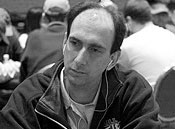
Player Snapshot
- Full name: Erik Seidel
- Nicknames: “Seiborg,” “Sly”
- Nationality: American
- Date of birth: November 6, 1959
- Hometown: New York City
- Current base: Las Vegas, Nevada
- Live tournament earnings: $48,710,630 (Hendon Mob, verified 11 April 2026; 15th on the all-time money list)
- WSOP bracelets: 10 (tied second all-time with Doyle Brunson, Johnny Chan, and Phil Ivey, behind Phil Hellmuth’s 17)
- WPT titles: 1 (Foxwoods Poker Classic, 2008)
- EPT titles: 1 (€100K Super High Roller, Grand Final 2015)
- Other major titles: Aussie Millions $250K Super High Roller (2011), NBC National Heads-Up Championship (2011), WPT World Championship $100K Super High Roller (2011)
- Poker Hall of Fame: Inducted 2010
- Playing style: Exploitative, adaptive, psychological
- Sponsors: None current (formerly Team Full Tilt until 2011)
Who Is Erik Seidel?
Erik Seidel is the quietest legend in poker. While Phil Hellmuth produces tantrums and Phil Ivey produces mystique, Seidel just produces results — and has done so for nearly four decades, longer than any active tournament player at the top tier. With 10 WSOP bracelets, more than $48.7 million in live earnings on the Hendon Mob, a 2010 Poker Hall of Fame induction, and a tenth bracelet won at age 64, he is the closest thing the modern era has to a counterexample for every theory about why poker careers don’t last.
The thesis of any honest Seidel profile is this: he is not the most naturally gifted player of his generation, and he would be the first to say so. What he is, instead, is the most durably curious. He came up at the Mayfair Club in New York alongside Stu Ungar, Howard Lederer, and Dan Harrington; survived Black Monday in 1987; outlasted the Moneymaker boom, Black Friday in 2011, the solver era, and the high-roller arms race. Each transition killed careers around him. He kept winning. In December 2023, at the inaugural WSOP Paradise in The Bahamas, he took down the $50,000 Super High Roller for $1,704,400 — his largest WSOP cash ever and the bracelet that tied him with Brunson, Chan, and Ivey for second on the all-time list.
That this profile needs to include a 2026 retirement note at all — driven not by skill loss but by a US tax-law change — tells you everything about how far Seidel pushed his career past its normal expiration date.
Early Life and Path to Poker
Seidel was born in New York City on 6 November 1959 and, by his own telling in a 2019 PokerNews interview, was a child for whom games were an escape from a school environment he didn’t much enjoy. He found backgammon early — by high school, he was already one of the best in his immediate circle, and at 17 he was invited into the legendary Mayfair Club, originally a bridge and backgammon room in Manhattan.
The Mayfair would become, in the 1980s, the most consequential poker incubator in American history. As ESPN’s Gary Wise documented in his 2011 profile of the club, the players who passed through it — Seidel, Harrington, Lederer, Steve Zolotow, Jay Heimowitz, Paul “X-22” Magriel, and a young Stu Ungar — built their advantage through something poker had never seen before: collective, rigorous, open analysis. They were, in Lederer’s recollection, “driven, rigorous guys who had a way of approaching various activities with the objectivity you need to be world-class.”
Seidel didn’t go straight from backgammon to poker. He attended Brooklyn College and Hunter College, then took a job on Wall Street, eventually trading options at PaineWebber and then alongside Mayfair regular Roger Low. The Black Monday crash of October 1987 wiped out his firm. He was, as he later put it, “on the streets again” — and back at the Mayfair, where poker was now the main game in the building. Six months later, a group of friends staked him into the 1988 World Series of Poker Main Event.
Career Timeline and Breakthrough
The 1988 WSOP was Seidel’s first major poker tournament. He had played the event with about 70% of his action sold to backers and had busted out of nine smaller events at the series before the Main started. Then he made the final table. Then he made heads-up, against the reigning champion Johnny Chan. Then, with Q-7 on a Q-10-8 flop, he walked into Chan’s slow-played J-9 — a flopped nut straight — and committed his stack on the turn. He finished second for $280,000.
The hand would be immortalised a decade later in the opening of Rounders (1998), where Matt Damon’s character watches the bust-out on grainy VHS. For Seidel, in his own words to PokerNews, it was “life-changing money at the time, and we had a kid on the way.” It was also, the Mayfair group decided, enough confirmation that he should turn pro.
The first bracelet came in 1992 — $2,500 Limit Hold’em, $168,000 — followed by another in 1993 ($2,500 Omaha 8) and a third in 1994 ($5,000 Limit Hold’em). In 1995, Seidel and his wife Ruah moved with their two daughters from New York to Las Vegas. Through 1998 to 2007 he added five more bracelets across No-Limit Hold’em, Pot-Limit Omaha, and 2-7 Lowball.
His peak came in 2011. After winning the Aussie Millions $250,000 Super High Roller in January for $2,472,555 — still his largest single cash — Seidel went on to win the NBC National Heads-Up Championship in March (beating Chris Moneymaker for $750,000), the LA Poker Classic High Roller in February, and the WPT World Championship $100K Super High Roller in May (beating Team Full Tilt teammate Erick Lindgren). The cumulative result was more than $6.5 million in winnings that year and a brief stay at number one on the all-time money list before Daniel Negreanu overtook him.
Then came a long bracelet drought. Between 2007 and 2021 — fourteen years — he reached more than a dozen WSOP final tables without winning one. His ninth bracelet finally arrived during the pandemic-era online series, when he won the GGPoker Super MILLION$ $10K High Roller in August 2021 for $977,842. Two years later, at age 64, he won bracelet number ten in the $50K Super High Roller at WSOP Paradise. As of late 2025 he was still inside the top 100 of the Card Player Player of the Year race after winning the PGT PLO Series II Event #3 for $171,500 — his 35th career title.
In April 2026 he told CNBC he was scaling his volume back to roughly a quarter of his usual 130-150 events per year, citing the new gambling-loss deduction limit in the One Big Beautiful Bill Act. He framed it as a semi-retirement, not a retirement: “I can afford to not play as much, but it’s a devastating thing for people who are much younger than me.”
Key Titles and Biggest Results
| Event | Year | Finish | Prize | Notes |
|---|---|---|---|---|
| Aussie Millions $250K Super High Roller | 2011 | 1st | $2,472,555 | Largest single cash of his career |
| EPT Grand Final €100K Super High Roller | 2015 | 1st | $2,222,222 | Won with a famous jack-high hero call vs. Urbanovich |
| Super High Roller Bowl, Las Vegas | 2016 | 3rd | $2,400,000 | One of his largest non-winning cashes |
| WSOP Paradise $50K Super High Roller | 2023 | 1st | $1,704,400 | 10th WSOP bracelet, at age 64 |
| EPT Barcelona €100K Super High Roller | 2022 | 2nd | $1,320,344 | |
| partypoker MILLIONS Bahamas $250K | 2019 | 4th | $1,275,000 | |
| WPT World Championship $100K SHR | 2011 | 1st | $1,092,780 | Defeated Erick Lindgren heads-up |
| WPT Foxwoods Poker Classic | 2008 | 1st | $992,890 | His sole WPT title |
| GGPoker WSOP Super MILLION$ HR | 2021 | 1st | $977,842 | 9th bracelet; first online bracelet |
| NBC National Heads-Up Championship | 2011 | 1st | $750,000 | Beat Chris Moneymaker in the final |
What the table shows, taken together, is something most casual profiles get wrong: Seidel is not primarily a tournament Hold’em specialist. His ten bracelets span Limit Hold’em, No-Limit Hold’em, Omaha 8 or Better, Pot-Limit Omaha, 2-7 Triple Draw, and Super High Roller mixed-format events. He is one of the most versatile bracelet winners in WSOP history. His career money also leans heavily on the high-roller circuit of the 2010s and 2020s, where he routinely finishes in the top 5 of fields stacked with players half his age. That’s not a tournament resume — that’s a study in adaptation.
Playing Style and Strategic Identity
The most useful window into how Seidel actually plays is Maria Konnikova’s 2020 New York Times bestseller The Biggest Bluff, which chronicles her year as his sole student. From that book, and from her subsequent interviews, a specific picture emerges that contradicts the lazy “tight-aggressive veteran” framing.
Seidel is, in Konnikova’s analysis, fundamentally exploitative rather than rigidly strategic. He doesn’t lock into a single style and apply it; he reads the table and chooses whichever style is least expected. Konnikova writes that “even skilled tight-aggressive players can be outmaneuvered because their strategy is transparent” — the elite move, the one Seidel embodies, is to be flexible enough that opponents cannot model you. As Seidel told her in one of the book’s most cited passages: “Of the great players, the ones who are some of the most exploitable are the ones who are really into math.”
That is a striking thing for a Mayfair-trained ex-backgammon-trader-trained options-trader to say, and it points to his real edge. Seidel respects solver-era theory — he plays high-stakes online events, he understands GTO frameworks — but he treats them as defaults to be deviated from, not laws to be obeyed. Konnikova said in a 2021 PokerNews interview that what shocked her most about him was the breadth of his interests: literature, Russian writers, music, basketball. He brings that breadth to the table in the form of more pattern-matching reference points than most opponents have access to.
His on-table demeanour is famously controlled. There is no Hellmuth-style needling, no Negreanu-style banter, no Ivey-style stare. Players who’ve sat with him — including Phil Hellmuth, who has lost to him heads-up at major events — describe him as friendly but largely silent. In a 2025 Card Player interview at the PokerStars NAPT in Las Vegas, Seidel noted that he isn’t actively chasing Hellmuth’s bracelet record because the format doesn’t suit him: “I’m not trying to chase him down, for sure.” He has also publicly said that bracelets, with hundreds now awarded annually across live, online, Paradise, and Europe, are “handed out like Halloween candy.”
Online Poker and Cash Games
Seidel is not primarily known as a cash-game pro. His public footprint is the live tournament circuit. He played online during his Team Full Tilt years through 2011, and after Black Friday he stayed mostly offline until the pandemic — when, in summer 2021, he flew to Mexico to play the GGPoker WSOP Online series and won the 10KSuperMILLION for $977,842. That was his ninth bracelet and his first online one. He has continued to play selected online high rollers since, with several deep runs but no further wins.
He has not been a regular on Hustler Casino Live or other high-stakes streaming cash games. Triton Poker has featured him in several events, where he is a regular if not always a deep finisher in their $25K-and-up tournament schedule.
Beyond the Felt
After Black Friday in April 2011, Seidel did not take another major sponsorship. His relationship with Full Tilt Poker ended with the site’s collapse, and per PokerNews he was “disgusted” at how the company had been run; he was not part of the management team, only a sponsored pro. He has remained unaffiliated since.
His most public extracurricular work is his mentorship of Maria Konnikova, the journalist and PhD psychologist who approached him in 2016 with no prior poker experience. Under his guidance she went from learning the rules of Hold’em to winning the 2018 PCA National Championship for $84,600 and accumulating more than $350,000 in tournament earnings. Her resulting book The Biggest Bluff (2020) became a New York Times bestseller and is now one of the most-recommended books in poker literature. Beyond Konnikova, Seidel has invested in AlleyNYC, a New York co-working space; he has appeared as himself in Rounders (briefly), Lucky You (2007), and Curb Your Enthusiasm; and PokerGO produced a full-length Pokerography episode on him in 2016 that features his daughters on camera.
He is a private person about his finances and his family. He is married to Ruah; the couple has two daughters, Jamesin and Elian. The family relocated from New York to Las Vegas in 1995. In an Entrepreneur magazine Q&A in 2014, conducted while he was at AlleyNYC with his daughter Jamesin, he gave a rare answer about how his own family had received his career choice: “My dad had a lot of reservations but eventually he was able to see it was something I loved and could also make a living and support a family with.”
Controversies and Complex Reputation
Seidel has, by the standards of a four-decade poker career, an almost unprecedented absence of public controversy. He has never been accused of cheating, never been involved in a major refused-payout dispute, and was widely cleared of any operational responsibility in the Full Tilt collapse despite his Team Full Tilt sponsorship. A 2018 Venmo hacking incident affected both him and Daniel Negreanu and was reported as a victim story rather than anything reflecting on him.
The single semi-recurring criticism is the one Seidel himself has acknowledged: that he can be quietly competitive to a degree some opponents read as cold. He has shrugged that off in interviews. It is, by any reasonable standard, not a controversy.
Current Status and What to Watch
As of May 2026, Seidel is technically semi-retired but not actually retired. His public statements to CNBC and Card Player make clear that he is reducing his tournament schedule by roughly 75% in response to the new US gambling-loss deduction limit, which caps deductible losses at 90% of winnings and effectively taxes gamblers on income they didn’t earn. He is avoiding $10K+ buy-in events for the same reason. He continues to play selectively, primarily smaller-buy-in events and the PokerGO Tour PLO series where he won his most recent title in October 2025.
What to watch over the next twelve months: whether the new tax provision is amended in any way by Congress (industry groups are lobbying), in which case Seidel could plausibly return to a full schedule and remains, even at 66, one of the few players capable of catching Phil Ivey at eleven bracelets. Watch also for any deep run at WSOP Paradise in The Bahamas this December, where his late-career resurgence began.
Frequently Asked Questions
According to the Hendon Mob database, as of 11 April 2026 Seidel has $48,710,630 in verified live tournament earnings, placing him 15th on the all-time money list. His cash-game results and total lifetime winnings are not publicly known, and he has consistently declined to discuss them.
Ten. He won his first in 1992 ($2,500 Limit Hold’em) and his tenth in December 2023 at WSOP Paradise in The Bahamas ($50,000 Super High Roller, $1,704,400). That ties him with Doyle Brunson, Johnny Chan, and Phil Ivey for second on the all-time bracelet list, behind only Phil Hellmuth at 17.
Exploitative and adaptive rather than fixed. According to Maria Konnikova’s The Biggest Bluff, where Seidel is the central mentor character, he plays the opponent and the situation rather than a pre-set strategy. He respects solver-era theory but treats it as a baseline to deviate from, not a rule. His on-table demeanour is calm and largely silent, in contrast to peers like Phil Hellmuth.
He was born in New York City on 6 November 1959 and grew up there. He honed his poker game at the legendary Mayfair Club in Manhattan in the 1980s alongside Dan Harrington, Howard Lederer, Steve Zolotow, and Stu Ungar. He moved with his wife and two daughters to Las Vegas in 1995 and has been based there since.
Yes, though at reduced volume. In April 2026 he told CNBC he was cutting his schedule to roughly a quarter of his usual 130-150 events per year, in response to a US gambling-loss deduction limit introduced in late 2025 that he described as making professional play “untenable” at his usual stakes. He continues to play selected smaller-buy-in events and PokerGO Tour series.
There is no reliable public figure. Erik Seidel has consistently declined to discuss his net worth, and his cash-game and investment results are private. Various media estimates have placed it in the range of $40-50 million, but these are extrapolations from his publicly known tournament earnings rather than verified figures. Treating any specific net worth claim about him as fact would be misleading.
Erik Seidel and his wife Ruah have two daughters, Jamesin and Elian. Both have appeared in PokerGO’s Pokerography episode about their father (2016), where they describe him as a present and engaged parent despite a demanding tournament career. The family moved from New York to Las Vegas together in 1995.
There is no verified appearance by Erik Seidel on the History Channel’s Pawn Stars. The search may be a confusion between Seidel and other poker-related episodes (the show, which is filmed in Las Vegas, has occasionally featured poker memorabilia segments, most notably with PokerNews writer Chad Holloway in 2012). Seidel’s documented on-screen appearances are in Rounders (1998), Lucky You (2007), the Pokerography documentary on him (2016), and a brief cameo in Curb Your Enthusiasm.