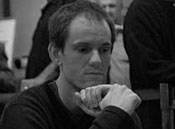
Player snapshot
| Full name | Allen Cunningham |
| Nickname | “Clever Piggy” |
| Nationality | American |
| Date of birth | 28 March 1977 |
| Hometown | Riverside, California |
| Current base | Las Vegas, Nevada |
| Live tournament earnings | $11,942,371 (Hendon Mob, latest cash 3 July 2024) |
| WSOP bracelets | 5 |
| WSOP Circuit rings | 2 |
| WPT titles | 0 (two final tables) |
| Best Main Event finish | 4th — 2006 ($3,628,513) |
| Major awards | 2005 ESPN/Toyota WSOP Player of the Year; 2006 ALL IN Magazine Player of the Year |
| Playing style | Patient, analytical, mixed-game disciplined |
| Past sponsors | Team Full Tilt (2006–2011) |
Who is Allen Cunningham?
Allen Cunningham is the most decorated player of his generation that the average sports fan has never quite heard of. Between 2001 and 2007 he won five WSOP bracelets — three of them in consecutive years from 2005 to 2007 — finished fourth in the 2006 Main Event for $3,628,513, and was named WSOP Player of the Year in 2005. He has logged $11.9 million in verified live tournament earnings (Hendon Mob, July 2024) without ever filming a YouTube vlog, launching a training site or starting a feud.
That is the point. In the post-Moneymaker boom, when poker’s emerging stars chased camera time as much as cards, Cunningham went the other way: monkish, analytical, and quiet enough at the table to develop a reputation among professionals as the most consistent all-round player at the WSOP for years on end. Twenty years on, Cunningham is tied with Johnny Chan for one of the most WSOP Main Event cashes in history (11), still travels selectively to the WSOP, and remains a reference point whenever poker writers want to discuss what discipline at the highest level actually looks like.
This profile traces how a UCLA engineering dropout from Riverside became a five-bracelet champion before 30, why he stepped back from the circuit, and what he has done since returning.
Early life and path to poker
Cunningham was raised in Riverside, California, by parents Dean and Joanne Cunningham. His introduction to cards came around the family kitchen table — wild-card variants and house rules of the kind every American home game shares — and he has said he realised early that he was unusually good at them.
After high school he won a scholarship to study civil engineering at UCLA. The classroom never quite took. While living with his parents, working as a pizza delivery driver, and visiting a local tribal casino — the only venue that would seat him under California’s casino age laws — Cunningham built a bankroll on low-stakes cash games and freerolls. In his second year of university the games clicked, he moved up from $2/$4 to $10/$20, and at 19 he dropped out of UCLA to play full-time. He was still too young to enter most non-tribal Californian rooms, so he spent the next two years sharpening up in Indian casinos — a longer apprenticeship in mixed and limit games than most of his peers ever served.
When he finally hit the major tournament trail at 21, Cunningham fell in with a small group of young grinders who would shape the next decade of poker: Phil Ivey, Daniel Negreanu, John Juanda and Layne Flack. By 1999 — voted Best All-Around Player at the Bicycle Casino’s Legends of Poker that year — he was no longer the youngest in the conversation. He was a contender.
Career timeline and breakthrough
First major mark (2000–2001). Cunningham travelled to Las Vegas for his first WSOP in 2000 and immediately cashed five times, including a runner-up finish in the $5,000 Limit Omaha Hi-Lo for $113,850. A year later, in June 2001, he won his first bracelet — the $5,000 Seven-Card Stud Championship — defeating a 104-player field for $201,760. The choice of game mattered: in a poker world tilting hard towards no-limit hold’em, Cunningham’s first title came in a high buy-in mixed-game classic. It set the pattern.
Breakthrough (2002–2005). A second bracelet followed in 2002 in the $5,000 No-Limit Deuce-to-Seven Draw Lowball event for $160,200 — another non-hold’em title, played against a small, sharp field. After two quiet years at the WSOP, Cunningham detonated 2005: he reached four final tables across the series, won the $1,500 No-Limit Hold’em event for $725,405, cashed for over a million dollars, and was named ESPN/Toyota WSOP Player of the Year. He was 28.
Career peak (2006–2007). The 2006 WSOP delivered Cunningham’s fourth bracelet — the $1,000 No-Limit Hold’em with Rebuys event, worth $625,830 — and then his most public moment. From a record-setting Main Event field of 8,773 entrants, Cunningham reached the nine-handed final table second in chips behind Jamie Gold (17.7M to 25.6M), and was favoured by most observers — including ESPN broadcaster Norman Chad — to chase down the chip leader. Gold instead extended his lead, and Cunningham was eliminated in fourth for $3,628,513 — the largest single payday of his career, and a result that, in his own framing at the time, was a disappointment. ALL IN Magazine named him 2006 Player of the Year regardless.
In June 2007 he completed something only a handful of players have ever managed: a third consecutive WSOP bracelet, in the $5,000 World Championship Pot-Limit Hold’em event for $487,287. The other names on that list — Doyle Brunson, Erik Seidel, Johnny Moss, Bill Boyd, Gary Berland — are largely Hall of Famers. Cunningham was 30.
Setback and slowdown (2008–2019). Cunningham joined Team Full Tilt in October 2006 and was a fixture on the site through Black Friday — 15 April 2011 — when the U.S. Department of Justice indicted Full Tilt’s executives and shut online poker out of the U.S. market. Unlike Howard Lederer and Chris Ferguson, who held executive roles, Cunningham was a player-representative; he was not personally implicated in the financial mismanagement that emerged later. His tournament output in the post-Black Friday years remained respectable — including a $500,000 share of the November 2010 Full Tilt Doubles Poker Championship with Huck Seed — but the volume slowed.
Hiatus and return (2019–present). According to BetMGM’s Greatest Forgotten Poker Players in Poker History feature, Cunningham took a break from poker around the middle of 2019 before returning roughly three years later. Hendon Mob’s recorded results align with that gap: his cashes thin out sharply through the early 2020s before resuming with the 2024 WSOP — a $1,821 cash in the $800 Deepstack and $17,500 for finishing 1,052nd in the Main Event from a field of 10,112. He remains based in Las Vegas and continues to play selectively at the WSOP each summer.
Key titles and biggest results
| Event | Year | Finish | Prize | Notes |
|---|---|---|---|---|
| WSOP Main Event ($10,000 NLH) | 2006 | 4th of 8,773 | $3,628,513 | Largest cash; runner-up to Jamie Gold |
| WSOP $1,500 No-Limit Hold’em | 2005 | 1st | $725,405 | Bracelet #3; final table included David “Devilfish” Ulliott, Scott Fischman |
| WSOP $1,000 No-Limit Hold’em w/ Rebuys | 2006 | 1st | $625,830 | Bracelet #4 |
| WSOP Circuit Caesars Palace Main Event | 2008 | 1st | $499,069 | First WSOP Circuit ring |
| WSOP $5,000 Pot-Limit Hold’em World Championship | 2007 | 1st | $487,287 | Bracelet #5; third bracelet in three years |
| L.A. Poker Classic Championship | 2006 | 5th of 693 | $389,050 | WPT main event final table |
| NPL Vegas Open Championship ($15,000) | 2007 | 1st | $325,000+ | Defeated David Singer heads-up |
| Poker After Dark “Mega Match” | 2007 | 1st | $300,000 | Televised cash event |
| WSOP $5,000 Seven-Card Stud Championship | 2001 | 1st | $201,760 | First bracelet |
| WSOP $5,000 No-Limit Deuce-to-Seven Draw | 2002 | 1st | $160,200 | Second bracelet |
All figures verified against Hendon Mob and WSOP.com.
What this collection shows, at a glance, is range. Three of Cunningham’s five bracelets came in $5,000+ buy-in events. Two of those — Stud and Deuce-to-Seven — are not no-limit hold’em. He has no World Poker Tour title but he has reached two WPT final tables. He has never won a WSOP Main Event but he is tied with Johnny Chan and ahead of nearly every player in WSOP history for cashes in it. The portrait is of a tournament player whose strongest single attribute is breadth: he can win at $5K Stud, $1K hold’em, $5K PLH, and $15K-buy-in invitationals in the same calendar window.
Playing style and strategic identity
Where many of Cunningham’s contemporaries built reputations on aggression and personality, his identity is constructed almost entirely around restraint. The reads on him have been consistent for two decades: patient pre-flop, disciplined with stack management, and analytical to the point of being almost expressionless at the table. Howard Lederer, on welcoming Cunningham to Team Full Tilt in 2006, called him the best all-around WSOP player of the previous two years — a description echoed by professionals who voted him Best All-Around Player Under 35 around the same time.
In a PokerListings interview before the 2006 Main Event final table, Cunningham described his approach as letting the slower structure favour the better player, sitting patiently, and waiting for spots. He acknowledged that his table image cuts both ways: some opponents play correctly against him, others overcorrect — assuming, for example, that he bluffs more often than he does and calling him too wide.
In practice that produces a tight, position-aware pre-flop range — he is rarely the table aggressor unless he holds an actual edge, which is why opponents who model him as loose-aggressive routinely pay him off. He reads situations more than personalities, working out where the average player sits in a given spot relative to chip stack and structure. And he adapts to format: three bracelets in three different disciplines (Stud, 2-7 Draw, Pot-Limit Hold’em) is the mechanical evidence of a player who studies whichever game he is currently sitting in. Cunningham predates the modern GTO solver era, and his game is grounded in feel and structural understanding more than memorised solver outputs. He has been candid in interviews that he has had losing periods and has had to keep improving — an admission that separates him from the more self-mythologising voices in his peer group.
Online and televised play
Cunningham was a Full Tilt sponsored pro from before October 2006 and a full Team Full Tilt member from October 2006 until the site’s collapse on Black Friday in April 2011. During that period he posted documented online results — including a heads-up chop of the Full Tilt $1K Monday for $83,835 in January 2011 — but, like most American pros of his generation, his recorded online output drops sharply after the U.S. market closed.
On television outside the WSOP broadcasts, his most prominent appearance was on NBC’s Poker After Dark, where he won the $50,000-buy-in “Mega Match” episode for $300,000 in October 2007. Beyond ESPN’s standard WSOP coverage from the mid-2000s onwards, including the 2006 Main Event final table, he has not built a broader television or streaming presence.
Beyond the felt
Cunningham has consistently kept his private life private. Long-running poker media — Hendon Mob, GPI, PokerListings, the Poker Wiki — describe him as living in Las Vegas with his long-term partner Melissa Hayden, a fellow professional poker player and former photojournalist, and a dog named Muffin. There is no publicly verified record of a marriage. He is not active on X/Twitter (his account shows zero posts as of late 2025) and has no documented training site, book, or coaching business — unusual for a player of his generation and stature.
His sponsorship history is brief and concentrated: Team Full Tilt from 2006 to 2011, with no significant publicly announced poker sponsorship since.
Current status and what to watch
Cunningham, now 49, plays a deliberately reduced schedule. His most recent verified result, per Hendon Mob, is the $17,500 cash for finishing 1,052nd in the 2024 WSOP Main Event from a field of 10,112. He continues to be based in Las Vegas, has not chased the high-roller circuit, and — unlike several of his Team Full Tilt peers — has not become a podcast or streaming personality.
For poker fans, the things to watch over the next twelve months are small in number: whether he plays a fuller WSOP schedule in summer 2026, whether he extends his Main Event-cash record further, and whether — at some point — he sits down for the long-form interview the modern era is owed. He has more bracelets than the vast majority of poker’s marquee names. The under-told story is what he has been thinking about the game for the last twenty years.
Frequently asked questions
Allen Cunningham was born on 28 March 1977. He was raised in Riverside, California, before later basing himself in Las Vegas, where he has lived for most of his professional career.
Cunningham has $11,942,371 in verified live tournament earnings according to The Hendon Mob, with his most recent cash recorded on 3 July 2024. That figure does not include cash games, online play or non-tournament income, all of which for poker professionals are private and not independently auditable.
Five. He won the $5,000 Seven-Card Stud (2001), $5,000 No-Limit Deuce-to-Seven Draw (2002), $1,500 No-Limit Hold’em (2005), $1,000 No-Limit Hold’em with Rebuys (2006) and $5,000 Pot-Limit Hold’em World Championship (2007). The 2005–2007 sequence makes him one of the few players to have won bracelets in three consecutive years.
He was born in Riverside, California, attended UCLA briefly to study civil engineering, and has been based in Las Vegas, Nevada since turning professional.
Yes, but on a sharply reduced schedule. According to BetMGM’s reporting, he stepped back from poker around 2019 and returned roughly three years later. His most recently recorded result is a $17,500 cash in the 2024 WSOP Main Event. He continues to attend the WSOP each summer.
Cunningham did not retire — he scaled down. After his peak run of 2005–2010, his tournament volume dropped, including a multi-year break from around 2019 to 2022 (per BetMGM). He has not chased the modern high-roller circuit, has not relocated to play online abroad, and has not built a content brand around poker. He continues to play selected events and remains based in Las Vegas.
There is no publicly verified record that Cunningham is married. He has been in a long-term relationship with fellow professional poker player Melissa Hayden, with whom he has lived in Las Vegas for many years, but neither has spoken publicly about a marriage. Reporting on his personal life is limited because Cunningham has historically declined media coverage of it.
There is no reliable, audited figure for Cunningham’s net worth. His verified live tournament earnings stand at $11,942,371 (Hendon Mob), but that figure does not capture cash games, undocumented online winnings, sponsorships from his Team Full Tilt years, or personal investments. Net worth estimates published by celebrity-finance websites for poker professionals are speculative and should be treated as such.
Cunningham’s most prominent television appearances have been on the WSOP broadcasts on ESPN — most notably the 2006 Main Event final-table coverage — and on NBC’s Poker After Dark, where he won the $50,000-buy-in “Mega Match” episode for $300,000 in October 2007. He has not built a broader television or streaming presence beyond these.