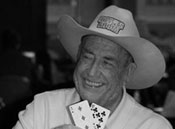
Player Snapshot
- Full name: Doyle Frank Brunson
- Nationality: American
- Born: 10 August 1933, Longworth, Texas
- Died: 14 May 2023, Las Vegas, Nevada (age 89)
- Based: Las Vegas, Nevada (from the mid-1960s onwards)
- Nicknames: “Texas Dolly,” “The Godfather of Poker”
- Live tournament earnings: $6,176,737 (The Hendon Mob, final career total; profile last updated post-mortem)
- WSOP bracelets: 10 (tied for third all-time with Johnny Chan and Erik Seidel, behind Phil Hellmuth and Phil Ivey)
- WSOP Main Event titles: 2 (1976, 1977 — back-to-back)
- WPT titles: 1 (2004 Legends of Poker — $1,198,260, career-best live cash)
- Poker Hall of Fame: Inducted 1988
- Playing style: Controlled aggression, intuitive, mixed-game specialist
- Notable books: Super/System (1978/79), Super System 2 (2004), The Godfather of Poker (2009 autobiography)
Who Is Doyle Brunson?
Doyle Brunson is the only player in poker history whose career stretched meaningfully across three distinct eras of the game — the illegal road-gambling circuit of 1950s Texas, the televised WSOP boom of the 1970s and 2000s, and the nosebleed mixed cash games of modern Las Vegas. He was playing at the top of the world when Richard Nixon was president, and he was still sitting in the Bellagio’s Big Game when the solver generation arrived. No other professional has come close to that span.
What matters is not just that he lasted, but that he led. Brunson won back-to-back World Series of Poker Main Event titles in 1976 and 1977, becoming only the second player to repeat as world champion. A year after the second victory he published Super/System, a book that — as the entire poker industry has since conceded — effectively created the modern strategy-content genre. He won ten WSOP bracelets, a World Poker Tour title, and spent most of his life inside the highest-stakes cash game in the building, wherever the building happened to be.
This profile focuses on what the record actually shows. Brunson’s life produced more legend than almost any figure in poker, and the legend sometimes runs ahead of the facts. The verified record — 10 bracelets, two Main Events, one WPT title, $6,176,737 in live tournament earnings per The Hendon Mob, Poker Hall of Fame induction in 1988 — is still, by any reasonable measure, the most complete résumé poker has produced.
Early Life and Path to Poker
Doyle Frank Brunson was born in Longworth, a tiny farming town in Fisher County, Texas, on 10 August 1933. He was one of three children and grew up during the Depression in a devout Baptist household — a faith he carried for the rest of his life and which, as he told interviewers repeatedly in later years, shaped nearly every decision he made away from the table.
He was a serious athlete long before he was a serious card player. At Sweetwater High School he won the one-mile event at the 1950 Texas Interscholastic Track Meet with a time of 4:43, and he was a genuine basketball prospect. He played college ball at Hardin–Simmons University in Abilene, where the NBA’s Minneapolis Lakers scouted him — a fact worth pausing on, because it is routinely soft-pedalled in profiles. The Lakers’ interest was real. A knee injury during his senior year ended his professional sporting ambitions and left him briefly on crutches. Brunson finished his bachelor’s degree in 1954 and a master’s in administrative education the following year, originally planning to become a school principal.
The pivot to poker happened almost by accident. Brunson had played five-card draw before his injury; during recovery, he played more, and he noticed the winnings were funding his life. A short-lived sales job at Burroughs Corporation ended on essentially his first day, when a seven-card stud game in a back room netted him more than a month’s salary. He left and never went back. By the late 1950s he was a full-time road gambler, playing illegal games on Exchange Avenue in Fort Worth with his childhood friend Dwayne Hamilton, and eventually traveling the Southern circuit with Thomas “Amarillo Slim” Preston and Brian “Sailor” Roberts. That circuit — run by organised crime, policed by no one, and occasionally interrupted by armed robbery — is the world Brunson described in his 2009 autobiography The Godfather of Poker, including the night a player at a nearby table was shot dead mid-hand.
Career Timeline and Breakthrough
Brunson and his Texas partners made their first serious Las Vegas trip in the mid-1960s, pooled their bankroll, and lost almost all of it — close to six figures between them. They split as gambling partners shortly afterwards. Brunson eventually settled in Las Vegas and, when Benny Binion invited a handful of the country’s top players to compete at the Horseshoe in 1970, he was in the room for what would become the World Series of Poker.
His first deep WSOP Main Event run came in 1972, when he finished third. But the career-defining stretch began in 1976. Brunson took down the $5,000 Deuce-to-Seven Draw event for $80,250 — his first bracelet — and then won the $10,000 No-Limit Hold’em World Championship for $230,000. The following year he did something only one player had done before (Johnny Moss) and only two have done since (Stu Ungar, Johnny Chan, in different circumstances): he won the Main Event back-to-back. His 1977 title paid $340,000, and his $1,000 Seven-Card Stud Split win earlier that summer gave him a third bracelet in four days. Both Main Events ended with the same hand. Brunson was all-in holding ten-deuce — offsuit in 1976, suited in 1977 — and made a full house on the river both times. Forty-nine years later, every poker room in the world still calls T-2 “the Doyle Brunson.”
By the end of the 1970s he had six bracelets in four years. Two more Main Event final tables followed — fourth in 1982, third in 1983 — but a long trophy drought set in. Brunson did not win another bracelet until 1991, another in 1998, and a ninth in 2003 in a $2,000 H.O.R.S.E. event that confirmed what Las Vegas had known for decades: he was not simply a Hold’em specialist but one of the strongest mixed-games players of any era.
The peak of his televised-era career arrived in August 2004, when he won the WPT Legends of Poker main event at the Bicycle Casino in Bell Gardens, California, for $1,198,260 — still his largest single tournament cash. Less than a year later, on 1 July 2005, he added his tenth WSOP bracelet, winning Event #31, the $5,000 No-Limit Hold’em 6-Max, for $367,800. The field of 301 was the largest he had ever topped. That win came less than a week after Johnny Chan had taken his own tenth bracelet, briefly leaving Chan alone at the top of the all-time list; Brunson’s victory restored the tie.
Tournament appearances thinned through the 2010s. Brunson openly said the hours no longer suited him, and he shifted his energy to the cash games at the Bellagio. He cashed in the 2013 Main Event — his fifth decade cashing in the event, a record unto itself — and then, on 11 June 2018, he announced his retirement from tournament poker, entered the $10,000 2-7 Single Draw Championship the same day, and promptly made the final table. He finished sixth for $43,963. It was his thirty-sixth WSOP cash and, effectively, his final competitive tournament result. He continued to make occasional public appearances — including a fifth-place finish in the 2021 WSOP MC Invitational, a novelty event — and played cash at the Bellagio into his late eighties.
Brunson died in Las Vegas on 14 May 2023, aged 89. The family did not disclose a cause of death. His wife Louise, to whom he had been married for 62 years, died just five months later. Daniel Negreanu and Phil Hellmuth spoke at his Celebration of Life at the 2023 WSOP.
Key Titles and Biggest Results
The following are Brunson’s most significant verified career results, compiled from The Hendon Mob and the official WSOP player database. All prize figures are in US dollars.
| Event | Year | Finish | Prize | Notes |
|---|---|---|---|---|
| WPT Legends of Poker — $5,000 NLHE Championship | 2004 | 1st | $1,198,260 | Career-best live cash; WPT title |
| WSOP Event #31 — $5,000 NLHE 6-Max | 2005 | 1st | $367,800 | 10th and final bracelet; largest field he ever won |
| WSOP $10,000 No-Limit Hold’em World Championship | 1977 | 1st | $340,000 | Second Main Event title; 4th bracelet |
| WSOP $10,000 No-Limit Hold’em World Championship | 1976 | 1st | $230,000 | First Main Event title; 2nd bracelet |
| WSOP $1,000 Seven-Card Stud Split | 1977 | 1st | $62,500 | 3rd bracelet |
| WSOP $5,000 Deuce-to-Seven Draw | 1976 | 1st | $80,250 | First WSOP bracelet |
| WSOP $2,000 H.O.R.S.E. | 2003 | 1st | — | 9th bracelet; mixed-game credentials |
| WSOP $1,500 Seven Card Razz | 1998 | 1st | — | 8th bracelet |
| WSOP $2,500 Pot-Limit Omaha | 1991 | 1st | — | 7th bracelet |
| WSOP $10,000 No-Limit 2-7 Single Draw | 2018 | 6th | $43,963 | Final WSOP cash; announced retirement that day |
Collectively, these results describe a player who was genuinely elite across variants rather than a Hold’em specialist who happened to enter other events. Brunson won WSOP bracelets in Deuce-to-Seven Draw, Seven-Card Stud Split, Seven Card Razz, Pot-Limit Omaha, H.O.R.S.E., and multiple No-Limit Hold’em formats. The tournament record is also, by modern standards, compact: $6.2 million in live earnings is well below what today’s high rollers can accumulate in a single good year. But the fields Brunson beat were smaller, the tours were fewer, and — as virtually every contemporary pro has acknowledged — his real income came from the cash games that do not appear on any database.
Playing Style and Strategic Identity
Brunson’s reputation is for aggression, but that description flattens what he actually did. The label he gave his own approach in Super/System was “Power Poker,” and the idea was less about raising relentlessly than about using the threat of a big bet to take control of every pot he entered. In No-Limit Hold’em specifically, he advocated betting into raisers with big hands, playing small pairs and suited connectors for implied odds, and — above all — leaning on the psychological weight of being the player willing to put his opponent to a decision for stacks.
In practice this translated into a reading-first style. Brunson was not a mathematician at the table. He was a pattern recogniser who had played, by his own estimate, hundreds of thousands of hours of live poker across a dizzying range of stakes and variants. He was known at the Bellagio for snap-calling large river bets with hands that made no sense on paper — and for being correct often enough that opponents adjusted rather than pressed. Observers in Bobby’s Room (renamed the Legends Room in his honour) consistently described his table presence as the real asset: the cowboy hat, the stillness, the willingness to play any game at any limit.
Modern solver work has not been kind to every recommendation in Super/System. His published preference for ace-king offsuit over ace-king suited, and his conservative preflop three-betting ranges, do not hold up to GTO analysis. But the core instincts — that a hand can be played several ways and all of them can be correct, that pressure creates mistakes, that position is worth more than most players realise — have aged well. Brunson himself said repeatedly in later interviews that he saw modern young professionals making moves he had been making for decades, and that the game had finally caught up to the style he and a handful of contemporaries had played out of necessity.
Against other top professionals his reputation was for adaptability rather than trickery. Phil Hellmuth, speaking publicly after Brunson’s death, credited him with inspiring three generations of players and with an unusually competitive refusal to accept losing sessions. Daniel Negreanu has consistently described him as the single most influential figure in the game’s history. What neither commentator emphasised, but what the record suggests, is that Brunson was primarily a cash-game player who happened to be brilliant in tournaments — not the other way around.
Cash Games, Super/System, and Doyle’s Room
Brunson was a fixture in what Las Vegas simply called “the Big Game” — the rotating high-stakes mixed-games session that moved over the years from the Dunes to the Mirage to Bobby’s Room at the Bellagio. Stakes in that game regularly ran at $4,000/$8,000 limit and higher, with pots occasionally in the six figures. He played in it, in some form, for more than forty years. Most credible estimates place his lifetime cash-game winnings well above his recorded tournament earnings, though the figures are by definition private and any specific number should be treated with caution.
His most lasting contribution to the game outside the felt is Super/System, self-published in 1978 under the original title How I Made $1,000,000 Playing Poker and priced at $100 a copy — an extraordinary figure for a book in the late 1970s. Brunson wrote the No-Limit Hold’em section himself and recruited specialists for the others: Mike Caro on Draw, David Sklansky on Seven Card Stud High-Low, Chip Reese on Seven Card Stud, Bobby Baldwin on Limit Hold’em, and Joey Hawthorne on Lowball. The book is universally described as the first serious strategy manual aimed at advanced players, and Brunson said repeatedly in later years that publishing it probably cost him more money than it ever earned him, because it taught his opponents how he played.
The sequel, Super System 2, appeared in 2004 with contributions from Negreanu, Johnny Chan, Jennifer Harman, Lyle Berman, and Todd Brunson — Doyle’s son, who would be inducted into the Poker Hall of Fame himself in 2016. Brunson also published According to Doyle (1984, later retitled Poker Wisdom of a Champion) and the autobiography The Godfather of Poker (2009).
His online venture, Doyle’s Room, launched in 2004 and ran through several networks before being seized by the US Department of Justice on 26 May 2011, about a month after the Black Friday indictments that dismantled the US online poker market. Brunson later said he had turned down a pre-Black Friday offer reported at roughly $235 million for the site — a figure that, if accurate, makes the seizure one of the single most expensive pieces of regulatory timing in poker history.
Beyond the Felt
Brunson was inducted into the Poker Hall of Fame in 1988 at the age of 54, and into the Hardin–Simmons University Athletics Hall of Fame as a basketball player many years later. Bluff magazine voted him the most influential figure in poker in January 2006.
He was also a survivor of multiple medically extraordinary events, the most significant of which is routinely underplayed. In late 1962, shortly after marrying his wife Louise, Brunson discovered a lump on his neck. Doctors in Texas found advanced melanoma — the cancer had progressed towards his brain — and told him he had three months to live. Louise was three months pregnant. At MD Anderson Cancer Center in Houston, surgeons opened his neck expecting to extend his life by a matter of months; they found the cancer had disappeared. His doctors described it, on the record, as a spontaneous remission. Brunson, who was deeply religious his entire life, attributed it to prayer and maintained that position publicly for the remaining 60 years of his life. He went on to survive at least three further, confirmed cancer operations — two for further melanomas and one for squamous cell carcinoma — between 2012 and 2020.
His family life was central to his public identity. He and Louise were married for 62 years. Their son Todd is a Poker Hall of Fame inductee and WSOP bracelet winner (2005 Omaha Hi-Lo). Their daughter Pamela played the WSOP Main Event in 2007. Their second daughter, Doyla, died in 1982 at the age of 18 from a heart-valve condition — a loss Brunson referred to in interviews but rarely in detail. Louise died in October 2023, five months after her husband.
Brunson made occasional appearances in film and television as himself, including the improvised comedy The Grand (2007), and consulted on other poker-related projects. For most of the 2000s he was the public face of Doyle’s Room.
Controversies and Complex Reputation
Two items of record belong here, not because they define Brunson but because responsible profiles should include them.
The first is the 2005 WPT Enterprises episode. In July 2005 Brunson made an unsolicited offer to purchase WPT Enterprises, Inc., the publicly traded owner of the World Poker Tour, at a premium to its then-market value. A public relations firm he had retained, and a website he endorsed, publicly announced the offer, which the SEC later said triggered a significant rise in WPT’s stock price on heavy trading volume. Brunson subsequently stopped responding to the WPT and to media enquiries, and when the silence became public, the stock fell sharply. On 14 December 2005 the SEC filed an action to enforce subpoenas seeking documents and testimony from Brunson’s attorneys. Brunson invoked the Fifth Amendment and asserted attorney–client privilege. The SEC dropped the case in 2007. No charges were ever brought, and Brunson publicly disputed any wrongdoing.
The second is the 2011 seizure of Doyle’s Room. On 26 May 2011, roughly a month after Black Friday, the site was seized by the US Department of Justice as part of a broader investigation into online gambling. Brunson distanced himself from the operation later that year. He was not personally indicted and never faced criminal charges in connection with the site; the seizure was part of a civil enforcement action against several operators.
Neither episode attracted the kind of sustained criticism that attached to some of his contemporaries, and Brunson’s standing in the poker community was broadly unaffected.
Legacy
Brunson retired from tournament poker in 2018, returned intermittently for appearance events, and continued to play high-stakes cash at the Bellagio until close to the end of his life. He died in May 2023 aged 89. The cause of death has not been publicly disclosed.
His legacy is best measured against the specific metrics that existed during his career. Ten WSOP bracelets places him, as of 2026, tied for third all-time behind Phil Hellmuth (17) and Phil Ivey (11), level with Johnny Chan and Erik Seidel. Two Main Event titles make him one of only four players ever to win the event more than once. The WPT Legends of Poker title in 2004 made him the first player to win both a WSOP Main Event and a WPT title — a list that has since grown to six. He was the first player to win $1 million in tournament poker. Beyond the record book, Super/System changed what poker content looked like and remains in print nearly five decades after its original self-publication.
What a poker fan should watch for now is what endures. The Bobby’s Room seat has been renamed the Legends Room in his honour. The T-2 hand will still draw a knowing smile at any poker table in the world in a generation’s time. And the broader question of whether anyone will again play at the top of the game across three distinct eras — cash-era, televised-era, and solver-era — is very likely answered: probably not.
FAQ
Doyle Brunson’s verified live tournament earnings totalled $6,176,737 at the time of his death, per The Hendon Mob. That figure covers recorded cashes from 1972 onwards. His lifetime cash-game winnings are not publicly documented but are widely estimated, by peers and by the poker press, to run to many multiples of his tournament total. Estimates of his peak net worth typically land around $75 million, though these are press-reported rather than audited.
Brunson won 10 WSOP bracelets across a career that ran from the 1970s to the 2000s. As of 2026 that total places him tied for third all-time with Johnny Chan and Erik Seidel, behind Phil Hellmuth (17) and Phil Ivey (11). His first bracelet came in the 1976 $5,000 Deuce-to-Seven Draw; his tenth, in the 2005 $5,000 No-Limit Hold’em 6-Max event, paid $367,800.
Brunson played a controlled-aggression, read-based style that he branded “Power Poker” in his strategy writing. He relied on table presence, pattern recognition, and a willingness to put opponents to difficult decisions for large portions of their stacks. He was also one of the strongest mixed-game players of his era, winning WSOP bracelets in at least seven different variants including Hold’em, Razz, Pot-Limit Omaha, H.O.R.S.E. and Deuce-to-Seven.
Brunson was born on 10 August 1933 in Longworth, a small farming town in Fisher County, Texas. He grew up in West Texas and attended Sweetwater High School before studying at Hardin–Simmons University in Abilene. He settled permanently in Las Vegas in the mid-to-late 1960s and lived there for the rest of his life.
Doyle Brunson died in Las Vegas on 14 May 2023 at the age of 89. He had formally announced his retirement from tournament poker in June 2018, though he continued to appear in occasional high-stakes cash games and novelty events — including the 2021 WSOP MC Invitational — in the years before his death.
His family has never publicly disclosed a cause of death. The initial statement released through his agent Brian Balsbaugh on 14 May 2023 confirmed his passing without specifying a medical cause. Brunson had survived multiple cancer operations over six decades, including a widely reported terminal melanoma diagnosis in 1962 that doctors at MD Anderson Cancer Center described as a spontaneous remission, as well as further melanoma and squamous cell carcinoma surgeries between 2012 and 2020.
Super/System, first self-published in 1978 under the title How I Made $1,000,000 Playing Poker, is a strategy guide covering No-Limit Hold’em (written by Brunson), Draw Poker, Seven-Card Stud, Stud Hi-Lo, Limit Hold’em and Lowball, with chapters contributed by Mike Caro, David Sklansky, Chip Reese, Bobby Baldwin and Joey Hawthorne. It is generally regarded as the first serious strategy manual aimed at advanced players, and is often called the “Bible of Poker.” A revised edition, Super System 2, was published in 2004 with contributors including Daniel Negreanu, Johnny Chan and Jennifer Harman. Brunson also published Poker Wisdom of a Champion (1984) and the autobiography The Godfather of Poker (2009).
Brunson won back-to-back WSOP Main Event titles in 1976 and 1977 holding ten-deuce in the final hand both times — in each case making a full house as an underdog on the river. The coincidence across two consecutive years cemented T-2 as “the Doyle Brunson” in poker nomenclature, and the nickname has persisted for nearly fifty years.