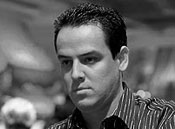
Player snapshot
| Full name | Juan Carlos Mortensen |
| Nickname | “El Matador” / “The Matador” |
| Nationality | Spanish (born in Ecuador) |
| Date of birth | April 13, 1972 |
| Born / base | Born in Ambato, Ecuador; raised in Madrid; has based himself between Spain and Las Vegas |
| Live tournament earnings | $12,107,757 (source: The Hendon Mob; figure unchanged since his last recorded cash in July 2017; verified June 2026) |
| WSOP bracelets | 2 |
| WPT titles | 3 |
| EPT titles | 0 (best EPT result: 11th, Monte Carlo, 2007) |
| Other major honours | Poker Hall of Fame (inducted 2016) |
| Playing style | Loose-aggressive (LAG) |
| Sponsors / team | None current |
Who is Carlos Mortensen?
Carlos Mortensen is the only person in poker history to win both the WSOP Main Event and the WPT World Championship — the two most prestigious open titles the game offers — and he is widely remembered as the last full-time professional to win the Main Event before the post-Moneymaker boom turned that title into an amateur’s lottery. His documented live tournament earnings stand at $12,107,757, a figure that has not moved since 2017 and that places him among the most successful European-based players of his generation.
Known to a generation of railbirds as “El Matador,” Mortensen built that résumé on a single, identifiable weapon: relentless, fearless aggression. Where contemporaries waited for hands, he applied pressure, and during the early-2000s television era his loose-aggressive style overwhelmed opponents who had no framework for handling it. The nickname was not marketing. It described how he played.
What makes Mortensen unusual is the combination of that aggression with a quiet, almost reluctant public profile. He never built a content empire, rarely courted controversy, and eventually drifted off the circuit without an announcement. The result is a player whose trophy cabinet is among the heaviest in the game, but whose name is recalled less often than peers with a fraction of his hardware. This profile is an attempt to correct that imbalance — and to answer, honestly, the questions people most often ask about him.
Early life and path to poker
Mortensen was born Juan Carlos Mortensen on April 13, 1972, in Ambato, Ecuador, to a Spanish mother and a Danish father — the Scandinavian surname that puzzles people who assume “El Matador” is purely Spanish comes from his father’s side. He spent his early childhood in Ecuador before the family relocated to Madrid in the mid-1980s. There he studied physics and mathematics at university, married young, and worked a string of ordinary jobs, including a bartending shift at a Madrid club.
His entry into poker reads like a piece of folklore, but the broad strokes are consistent across published accounts. In 1997, around the time of his 25th birthday, Mortensen sat in on a card game at the club where he worked, bought in for roughly $100, and lost the lot. The loss bothered him enough that he spent the night reworking how he had played, returned the next evening, and embarked on a winning run that stretched over months and eventually let him quit his job to play full time. Because organised gambling was restricted in Spain at the time, his local opponents dried up, and he made the decision that defined his career: he moved to the United States in the late 1990s to play poker for a living. It was in America, where players struggled with “Juan Carlos,” that he became simply Carlos Mortensen.
Career timeline and breakthrough
Mortensen’s first meaningful cash came at the World Series of Poker in 2000, when he finished seventh in a $3,080 No-Limit Hold’em event. It was a modest start, but it signalled that a relatively unknown European grinder could go deep against the establishment.
The breakthrough arrived a year later and was total. At the 2001 WSOP Main Event, Mortensen outlasted a then-record field of 613 entrants — at the time the largest live poker tournament ever staged — and navigated a final table stacked with established names: Mike Matusow finished sixth, 1989 world champion Phil Hellmuth fifth, and Phil Gordon fourth. Heads-up, Mortensen held King-Queen against the pocket aces of veteran Dewey Tomko and improved to a winning hand on the river to claim the title, his first bracelet, and $1,500,000. He added a second bracelet in 2003, winning a $5,000 Limit Hold’em event for $251,680 and proving the 2001 win was no fluke of variance.
His career peak, by the numbers, came on the World Poker Tour. Mortensen won his first WPT title in 2004 at the Doyle Brunson North American Poker Championship for $1,000,000, and in April 2007 he captured the WPT World Championship for $3,970,415 — his largest cash, the biggest prize in WPT history to that point, and the result that made him the first player ever to win the championship events on both major tours. A third WPT title followed in 2010 at the inaugural Hollywood Poker Open, putting him in a small club of players with three or more WPT crowns.
There was one more deep run worth remembering, and it is the result most rival profiles underplay. In 2013, more than a decade after his Main Event win, Mortensen finished 10th in the WSOP Main Event for $573,204 — missing the televised “November Nine” final table by a single elimination. For a player long cast as a relic of the boom, going that deep in a modern, GTO-literate field was a quiet vindication of his instincts.
Since then, the record goes quiet. His last recorded tournament cash on The Hendon Mob is dated July 2017, and his lifetime earnings figure has not changed since.
Key titles and biggest results
| Event | Year | Finish | Prize | Notes |
|---|---|---|---|---|
| WPT World Championship | 2007 | 1st | $3,970,415 | Largest WPT prize of its era; sealed the WSOP+WPT double |
| WSOP Main Event | 2001 | 1st | $1,500,000 | Beat a then-record 613-player field; first bracelet |
| WPT Doyle Brunson North American Poker Championship | 2004 | 1st | $1,000,000 | First WPT title |
| WSOP Main Event | 2013 | 10th | $573,204 | Missed the final table by one spot |
| WPT Hollywood Poker Open | 2010 | 1st | $393,820 | Third WPT title |
| WSOP $5,000 Limit Hold’em | 2003 | 1st | $251,680 | Second bracelet |
| Foxwoods World Poker Finals $5,000 NLHE | 2009 | 1st | $152,857 | WPT-era title outside Las Vegas |
Collectively, these results identify Mortensen as a genuine big-event closer, not a final-table also-ran. Two of the three biggest open titles in the sport, three WPT crowns, and a deep modern Main Event run are not the profile of a one-hit wonder who spiked the 2001 Main Event and faded. They describe a tournament specialist who repeatedly won when the fields were largest and the money was deepest.
Playing style and strategic identity
Mortensen’s reputation rests on controlled aggression. His table image was that of a player who would put chips in the pot with a wide range, apply pressure on every street, and force opponents to make decisions for their tournament lives without a clear read. During the early television era this was genuinely disruptive: many of the old-school professionals he faced were built to wait for strong hands, and Mortensen’s willingness to attack weakness — to bluff, to three-bet light, to take calculated gambles for the lead rather than for survival — broke their rhythm. That is the behaviour the “El Matador” nickname was coined to describe.
The more interesting and less discussed point is that this was not reckless gambling. The 2013 Main Event run, deep into the era of solver study and hand-range thinking, suggests a player whose aggression was underpinned by sound fundamentals and an unusually good feel for an opponent’s strength. He read situations rather than relying purely on hand strength, and he was willing to be the one dictating terms.
His most distinctive on-table signature, though, has nothing to do with betting. Mortensen is famous for building elaborate sculptures and towers out of his chips between hands — an idiosyncrasy fans still search for by name. It looks like a nervous habit, but it doubles as table image: a relaxed, almost playful presence at odds with the pressure he was applying with his stack. Few players in the game’s history have been as instantly recognisable by the state of their chips. Among his peers, contemporaries such as Daniel Negreanu and the players he repeatedly beat at WPT final tables, including Erik Seidel and John Juanda, competed against him in exactly the high-pressure spots where that aggression was most effective.
Beyond the felt
Mortensen’s profile away from the tournament floor has always been modest by modern standards. He appeared in the televised circuit programming of the boom era — including invitational events such as the Poker Superstars Invitational Tournament — but he never built the sponsorship, training-site, or streaming presence that defined the next wave of professionals. He is not currently attached to a team or sponsor.
His defining off-felt honour came in October 2016, when he was inducted into the Poker Hall of Fame alongside Todd Brunson — fittingly, in the same downtown Las Vegas room where he had won the 2001 Main Event. At the ceremony he thanked his family, and the induction formally cemented a legacy that his understated public persona had sometimes obscured. Within Spanish poker specifically, he is one of the country’s two most decorated tournament players, alongside the younger Adrián Mateos.
Current status and what to watch
The honest answer to “is Carlos Mortensen still playing?” is that he has effectively stepped away from the tournament circuit. His earnings have not moved since his last recorded cash in July 2017, and he has made no significant public appearances on the major-tour schedule in the years since. He has not, however, issued a formal retirement announcement, so the door is not officially closed.
For a player of his calibre, that ambiguity is the story. Boom-era champions occasionally resurface for a single marquee event or a Main Event return, and Mortensen’s 2013 deep run proved he can still compete with the modern field when motivated. What a fan should watch for over the next 12 months is precisely that: a one-off return to a high-profile event. If El Matador sits down at a WSOP or WPT table again, it would be one of the more meaningful comebacks in the game — not because he needs to prove anything, but because almost no one else holds the résumé he would be defending.
Frequently asked questions
Mortensen has won $12,107,757 in live tournament earnings, according to The Hendon Mob (verified June 2026). That figure covers documented live tournament results only and has not changed since his last recorded cash in July 2017; it does not include private cash-game or online winnings.
There is no reliable, verifiable net-worth figure for Mortensen, and any specific number should be treated with caution. Published “net worth” estimates for poker players are speculative because cash-game and online results are private. The only hard, sourced figure is his roughly $12.1 million in live tournament earnings.
He has two WSOP bracelets: the 2001 Main Event and a 2003 $5,000 Limit Hold’em event. He also won three World Poker Tour titles, making him the only player to win the championship events of both the WSOP and the WPT.
Mortensen is a loose-aggressive (LAG) player, nicknamed “El Matador” for his relentless pressure and willingness to bluff and gamble for the chip lead. His aggression was underpinned by strong reads and fundamentals, as his 10th-place finish in the 2013 Main Event — deep into the modern era — demonstrated.
He was born Juan Carlos Mortensen on April 13, 1972, in Ambato, Ecuador, to a Spanish mother and a Danish father, and was raised in Madrid. He competes under the Spanish flag and is regarded as the only player born in South America to win the WSOP Main Event.
He has not formally announced retirement, but he has effectively stepped away from competitive poker. His last recorded tournament cash was in July 2017, and his earnings total has been static since. A future one-off return to a major event is possible but unconfirmed.
Mortensen was previously married to fellow poker player Cecilia Reyes Mortensen, whom he met in Spain before his rise to fame; the couple divorced in 2006. Details of his personal life since then are not publicly documented, and reliable sources do not confirm a current spouse by name.